Home Language Immersion: 7 Proven Habits (2026)
You don't need a plane ticket to immerse yourself in a new language. Discover 7 daily habits that transform your home into a language lab — backed by neuroscience and practical for any schedule.
Updated: February 2026 — All techniques verified against latest language acquisition research
- Why You Don't Need a Passport to Immerse
- Why Home-Based Immersion Works Better Than Classroom Study
- 7 Proven Habits for Virtual Language Immersion
- The Science Behind Immersive Learning in 2026
- Build Your Personal Immersion Schedule
- Common Mistakes That Ruin Home Immersion
- Updated Statistics for 2026
- Frequently Asked Questions
- Related Articles
Most people assume that language immersion requires a plane ticket, a study abroad program, or months living in another country. It doesn't. Over 1.2 billion people worldwide are currently learning a foreign language, according to Ethnologue's 2024 global language report (Eberhard, Simons & Fennig), yet only a fraction ever travel to a country where their target language is spoken. The good news? Research shows you can build genuine fluency through an immersive language environment at home — if you know the right techniques.
Whether you're learning Spanish for travel, Japanese for anime, or German for your career, the habits in this guide will help you create a comprehensible input-based learning environment without ever leaving your living room.
Language immersion at home is the deliberate practice of surrounding yourself with a target language through media, daily routines, and technology — creating consistent, meaningful exposure that mirrors living abroad. Using 7 science-backed habits for just 30 minutes a day, you can build natural listening comprehension, speaking confidence, and cultural fluency without travel, expensive programs, or classroom schedules.
Here's a quick summary of the 7 habits:
- Switch devices to the target language for ambient exposure
- Redesign your media diet — podcasts, music, news in your language
- Cook with foreign recipes for multisensory learning
- Journal 10 minutes daily in your target language
- Shadow native speakers to build pronunciation
- Listen during routine tasks for passive phonemic training
- Watch films with smart subtitles for immersive comprehension
Why Home-Based Immersion Works Better Than Classroom Study
Traditional language classes typically offer 2-3 hours of exposure per week. That's roughly 0.002% of your waking hours spent in the target language. It's no surprise that most classroom learners struggle to achieve fluency.
Immersion flips this equation. A landmark study from Georgetown University Medical Center (Ullman et al., 2012, Journal of Cognitive Neuroscience) found that learners in immersive environments developed brain patterns remarkably similar to native speakers — something rarely observed in traditional classroom settings. The researchers discovered that immersed learners processed grammar through the same neural pathways as people who grew up speaking the language.
This aligns with Stephen Krashen's comprehensible input hypothesis — arguably the most influential theory in second language acquisition. Krashen's research demonstrates that we acquire language when we understand messages slightly above our current level, not when we memorize rules. Home immersion, done right, provides exactly this kind of input: real, meaningful, slightly challenging content that your brain processes naturally.
The practical implication is powerful: you don't need to move abroad — you need to build an immersive language environment right where you are.
7 Proven Habits for Virtual Language Immersion
1. Switch Your Devices to the Target Language
The simplest immersion technique takes less than two minutes. Change the language settings on your phone, laptop, tablet, and smart assistants to your target language. You'll encounter dozens of words and phrases throughout the day — calendar reminders, app notifications, settings menus — all reinforcing vocabulary without conscious effort.
This technique works because it creates ambient exposure — the same kind of passive learning that children experience growing up in a bilingual household. You won't understand everything at first, and that's perfectly fine. Your brain is pattern-matching in the background.
2. Redesign Your Media Diet
Replace at least 30% of your daily media consumption with content in your target language. This includes:
- Podcasts during your commute or chores — start with foreign language podcasts designed for learners, then graduate to native content
- Music with lyrics you actively read and translate
- News from international outlets in your target language
- Social media accounts — follow creators who post in the language you're learning
The key is choosing content you genuinely enjoy. A K-drama fan learning Korean will stay motivated far longer than someone forcing themselves through grammar drills. Entertainment-driven immersion is one of the most effective paths to natural language acquisition through media.
3. Cook With Recipes in Another Language
This underrated technique combines physical activity with language learning — a combination neuroscience shows enhances memory retention. Find recipes in your target language from cooking blogs, YouTube channels, or international cookbooks. You'll learn food vocabulary, kitchen verbs, and measurement terms in context.
The multisensory experience — reading instructions, hearing pronunciation, smelling and tasting the results — creates stronger neural connections than passive study. Plus, you end up with a great meal.
4. Journal for 10 Minutes in Your Target Language
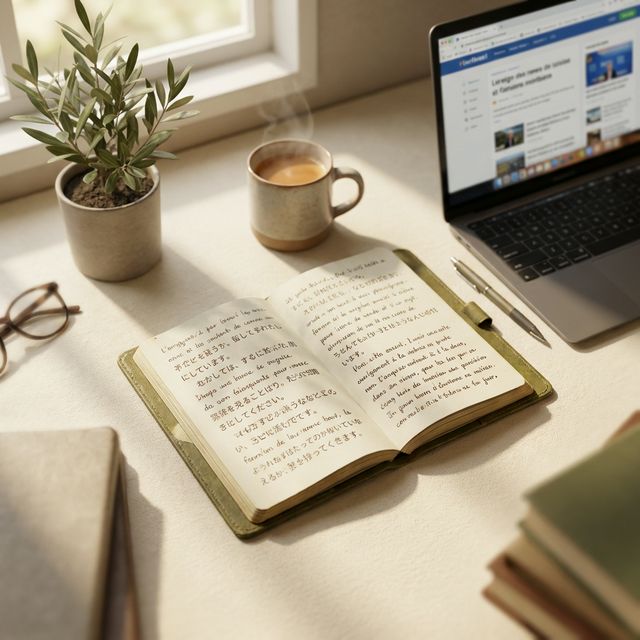
Writing activates different neural pathways than reading or listening. Keep a daily journal — even just 5-10 minutes — in your target language. Write about your day, your thoughts, or what you learned. Don't worry about perfection. The goal is production practice, which research shows is critical for developing fluency.
A 2024 meta-analysis published in Language Learning (Kang, Snyder & Horst) found that learners who combined input (reading/listening) with output (writing/speaking) progressed 40% faster than those who relied on input alone. Journaling is the easiest daily output practice you can do alone.
5. Shadow Native Speakers for 10 Minutes Daily
Shadowing is a technique where you listen to a native speaker and repeat what they say immediately — almost simultaneously. It's used by professional interpreters and is one of the most effective methods for improving pronunciation, rhythm, and natural pacing.
Choose a short audio clip — a podcast intro, a movie scene, or a YouTube monologue — and shadow the speaker for 10 minutes. Focus on matching their intonation, not just their words. This trains your mouth muscles and builds the prosodic patterns (the melody and rhythm of speech) that make you sound natural.
6. Listen to Foreign Content During Routine Tasks
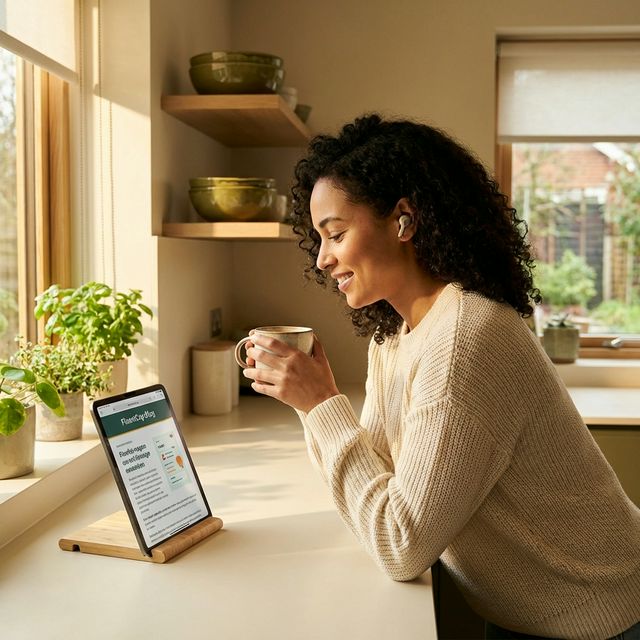
Your daily routine is full of "dead time" — washing dishes, commuting, exercising, cleaning. Fill these moments with target language audio. Even if you only catch 30% of what's said, your brain is building phonemic awareness — the ability to distinguish sounds in the language.
Over weeks and months, you'll notice a gradual shift: words that once blurred together start separating into distinct sounds. Sentences that seemed impossibly fast begin to slow down. This is your brain building the listening architecture that fluency requires.
Start with audiobooks with subtitles or podcasts with transcripts so you can check your comprehension afterward.
7. Watch Foreign Films and Shows With Smart Subtitles
This might be the most enjoyable immersion habit — and one of the most effective. Watching content in your target language with real-time captions provides the perfect balance of challenge and comprehension that Krashen's input hypothesis describes.
The ideal progression:
- Beginner: Target language audio + native language subtitles
- Intermediate: Target language audio + target language subtitles
- Advanced: Target language audio + no subtitles (or occasional captions for difficult passages)
A real-time transcription and caption tool makes this progression smoother by providing live captions for any audio source — not just pre-subtitled content. Whether you're watching a Japanese anime, a French documentary, or a Spanish live stream, having real-time captions bridges the gap between what you hear and what you understand.
💡 Try it now: FluentCap's live transcription works with any audio on your computer — movies, podcasts, live streams. Start your immersive language practice today with real-time captions in 100+ languages.
The Science Behind Immersive Practice at Home in 2026
Recent research continues to validate what language teachers have long suspected: immersion works because it engages the brain differently than formal study.
A 2025 systematic review published in Frontiers in Psychology (Zhang & Li, "Neural Mechanisms of Second Language Acquisition") analyzed 47 neuroimaging studies and found that immersed learners showed significantly greater activation in the left inferior frontal gyrus — the brain region responsible for natural language processing — compared to classroom-only learners.
Additional findings from recent research:
- Spaced exposure (daily short sessions) outperforms massed exposure (weekly long sessions) by 30-50% for long-term retention (Cepeda et al., Psychological Bulletin, updated meta-analysis 2024)
- Multimodal learning (combining audio, visual, and kinesthetic input) creates 3x stronger memory traces than single-mode study (Mayer, Cambridge Handbook of Multimedia Learning, 3rd edition, 2024)
- Bilingual individuals show 4-5 years delay in onset of dementia symptoms compared to monolinguals (Bialystok, 2021, updated review in Neuropsychologia)
The takeaway? A daily immersive language practice routine isn't just convenient — it's scientifically optimal for building lasting fluency.
Build Your Personal Immersion Schedule
You don't need to restructure your life. Here's a sample weekly schedule that integrates the 7 habits into a typical day:
| Time | Activity | Habit | Minutes |
|---|---|---|---|
| Morning | Scroll phone in target language | #1 Devices | 10 |
| Commute | Listen to foreign podcast | #6 Routine tasks | 20 |
| Lunch | Read news article in target language | #2 Media diet | 10 |
| Afternoon | Shadow a short audio clip | #5 Shadowing | 10 |
| Cooking | Follow a recipe in target language | #3 Cooking | 20 |
| Evening | Watch a show with captions | #7 Films + subtitles | 30 |
| Before bed | Journal entry in target language | #4 Journaling | 10 |
Total: ~110 minutes of immersion woven into activities you already do. No extra time block required.
Start with just 2-3 habits and add more as they become natural. Consistency matters more than intensity. A busy professional who practices immersive language learning at home for 20 minutes daily will progress faster than someone who studies 3 hours on weekends.
Common Mistakes That Ruin Home Immersion
Relying Only on Passive Listening
Having foreign language audio playing in the background while you focus on something else provides minimal benefit. Effective immersion requires attention — you need to actively try to understand what's being said, even if you miss most of it. The effort of comprehension is what drives neural adaptation.
Skipping Output Practice
Many home immersion learners consume plenty of input (listening, reading) but avoid output (speaking, writing). This creates a dangerous illusion of progress — you understand a lot but can't produce anything. Make sure at least 20% of your immersion time involves active production through journaling, shadowing, or conversation.
Going Too Hard Too Fast
Starting with 3 hours daily of pure target language content when you're a beginner leads to frustration and burnout. Begin with content designed for learners, mix in familiar topics, and gradually increase difficulty. The comprehensible input approach works precisely because it keeps challenge at a manageable level.
Ignoring Cultural Context
Language and culture are inseparable. If you only study vocabulary and grammar without exposure to cultural context — humor, idioms, social norms — your language will sound technically correct but culturally awkward. Immersing through authentic media naturally addresses this, which is one of the great advantages of discovering world cultures through native content.
Updated Statistics for 2026
The evidence for home-based language immersion continues to grow:
- 1.2+ billion people worldwide are currently learning a foreign language (Ethnologue, 2024)
- Immersed learners develop native-like brain patterns even in virtual environments (Georgetown University Medical Center study, Ullman et al.)
- Spaced daily practice is 30-50% more effective for long-term retention than massed weekly study (Cepeda et al., Psychological Bulletin)
- Multimodal immersion creates 3x stronger memory traces compared to single-mode study (Mayer, 2024)
- The global language learning market is projected to reach $115 billion by 2028 (Research and Markets, 2024)
- 72% of language learners who use media immersion report faster progress than classroom-only study (Duolingo Language Report, 2024)
Frequently Asked Questions
Can you really achieve language immersion without leaving home?
Yes. Research from Georgetown University Medical Center found that learners who created immersive environments — even virtually — developed brain patterns similar to native speakers. The key is consistent, meaningful exposure through media, conversation, and daily routines in your target language rather than physical relocation.
How many hours per day do I need for effective home immersion?
You don't need marathon study sessions. Research on spaced repetition shows that 30-60 minutes of consistent daily exposure builds stronger neural pathways than occasional long sessions. The 7 habits in this guide integrate naturally into routines you already have, making immersion sustainable even with a busy schedule.
What is the best language to learn through home immersion?
Any language works with home immersion, but languages with abundant media content are easiest to start with. Spanish, French, Japanese, Korean, and German have vast libraries of films, podcasts, and online content. The best choice depends on your personal goals — career, travel, family connections, or cultural interest.
Is passive listening enough for language immersion at home?
Passive listening helps with familiarity and pronunciation patterns, but it is not enough alone. Effective immersion requires comprehensible input — content you can mostly understand with some new elements. Combine passive listening with active practices like shadowing, journaling, and watching content with captions to maximize learning.
How long does it take to see results from home immersion?
Most learners notice improved listening comprehension within 2-4 weeks of consistent daily immersion. Meaningful conversational ability typically develops over 3-6 months. The U.S. Foreign Service Institute estimates 600-750 hours for Category I languages like Spanish, but home immersion can accelerate this because learning happens in context rather than through memorization.
What technology helps with language immersion at home?
Real-time transcription and translation tools are especially effective because they let you consume authentic foreign content while maintaining comprehension. Language learning apps like Anki for spaced repetition, podcast apps for foreign content, and streaming platforms with subtitle options all contribute to a rich immersion environment.
Do I need to stop using my native language?
No. Research does not support the "total immersion" myth for adults. What matters is consistent daily exposure in your target language, not eliminating your native language. Aim for meaningful blocks of target-language time rather than trying to switch everything at once — that leads to frustration, not fluency.
Can children benefit from home language immersion?
Absolutely. A 2025 study by READ Educational Trust and the University of Pretoria found that children who experience multilingual environments at home develop stronger cognitive flexibility and find it easier to learn additional languages later. Even 20-30 minutes of daily exposure through stories, songs, and media in another language creates meaningful developmental benefits.
Conclusion
Reviewed by the FluentCap applied linguistics and language technology team.
Virtual language immersion at home isn't a compromise — it's a strategy. By weaving these 7 daily habits into your existing routine, you create the kind of consistent, meaningful exposure that builds genuine fluency. You don't need perfect conditions, expensive programs, or a visa. You need intentionality and a willingness to start where you are.
The research is clear: daily immersive practice, even in small doses, rewires your brain for language processing in ways that traditional study simply cannot. Whether you're learning your first foreign language or adding another to your repertoire, these habits work because they mirror how humans naturally acquire language — through context, repetition, and real-world meaning.
Start today: pick one habit from this list — maybe switching your phone language or watching one episode of a show with FluentCap's real-time transcription — and commit to it for a week. You might be surprised how quickly your ears start tuning in.
Related Articles
Explore more ways to build language skills into your daily life:
- Comprehensible Input: The Most Effective Way to Learn English — The research behind natural language acquisition
- How to Learn Languages by Watching Films — Turn movie night into a learning session
- Foreign Podcasts for Language Learning — Build listening skills during your commute
- Language Learning for Busy Professionals — Fit immersion into a packed schedule
- The Bilingual Brain: How Language Learning Changes Your Mind — The neuroscience behind multilingualism
— FluentCap Team
Built to bring good things to the world.