Learn a Language by Watching Movies — What Research Actually Says
A National Bureau of Economic Research study found that countries using subtitles instead of dubbing score significantly higher in English proficiency. Here is the research behind learning a language by watching movies — and how to apply it effectively.
- TL;DR — Can You Really Learn a Language by Watching Movies?
- What Research Says About Learning a Language by Watching Movies
- Why Your Brain Learns Faster From Films
- The Subtitle Strategy: Which Type Works Best
- A Practical Method for Learning From Films
- How FluentCap Turns Any Film Into a Language Lesson
- Films Worth Starting With
- Mistakes That Slow Your Progress
- Thank You to Our Providers
- Scientific References
- Frequently Asked Questions
TL;DR — Can You Really Learn a Language by Watching Movies?
Yes — and the research is strong. If you have ever wondered whether you can truly learn a language by watching movies, the science is on your side. A National Bureau of Economic Research (NBER) study found that countries using subtitles instead of dubbing score significantly higher on English proficiency tests. A University of East Anglia meta-analysis confirmed that same-language subtitles produce large vocabulary gains regardless of proficiency level.
The key factors:
- Same-language subtitles (matching audio) produce the strongest learning effects
- Films provide comprehensible input for language learning — language embedded in visual context
- Low-stress, high-engagement environment lowers the brain's "affective filter"
- Tools like FluentCap generate real-time subtitles for any content
What Research Says About Learning a Language by Watching Movies
You have probably heard that watching movies in a foreign language helps you learn. But does the science actually back this up — or is it just a convenient excuse to watch Netflix?
The science backs it up. Strongly.
In 2019, economists Augustin Bergeron and co-authors published a working paper through the National Bureau of Economic Research (NBER) examining the long-run effects of subtitling versus dubbing across European countries. Their finding was striking: countries that historically used subtitling for foreign TV content showed significantly higher English proficiency than countries that used dubbing. This effect held even after controlling for education systems, GDP, and other variables.
This is not a small classroom experiment. It captured decades of population-level data and revealed that passive exposure to subtitled audiovisual content creates measurable language gains across entire nations.
At the individual level, the evidence is equally compelling. A meta-analysis by researchers at the University of East Anglia examined studies on intralingual subtitles (same-language subtitles matching the audio) and found a large positive effect on vocabulary learning regardless of how vocabulary was tested or the learner's proficiency level.
The question is not whether films help you learn a language. The question is how to maximize their effectiveness.
Why Your Brain Learns Faster From Films
Krashen's Comprehensible Input
The theoretical foundation for film-based language learning comes from linguist Stephen Krashen, whose Input Hypothesis has shaped second language acquisition research for over four decades.
Krashen's core idea: we acquire language when we understand messages that are slightly beyond our current level — what he calls "i+1." Not through grammar drills. Not through memorization. Through meaningful, comprehensible messages.
Films are perhaps the ideal vehicle for comprehensible input because they combine spoken language with visual context — gestures, facial expressions, settings, and story — that helps you understand messages even when individual words are unfamiliar.
According to a review published by the ERIC (Education Resources Information Center), Krashen's hypotheses have generated extensive research supporting the idea that comprehensible input methods are more effective for language acquisition than traditional grammar-focused instruction.

Dual Coding: Two Channels, Stronger Memory
When you learn a word from a vocabulary list, your brain creates one memory trace. When you learn that same word while watching a character express the emotion behind it — hearing the tone, seeing the facial expression, understanding the context — your brain creates multiple interconnected memory traces.
This is the basis of dual coding theory, developed by psychologist Allan Paivio. Information encoded through both verbal and visual channels is remembered significantly better than information encoded through a single channel.
Films naturally provide dual coding. The word "betrayal" hits differently when you hear it spoken by a character whose face shows devastation — and that emotional context makes the word nearly unforgettable.
The Affective Filter: Learning Without Stress
Krashen also proposed the Affective Filter Hypothesis: when learners feel anxious, stressed, or bored, a mental "filter" blocks incoming language from being acquired, even if it is comprehensible.
Films lower this filter dramatically. You are not being tested. You are not performing for a teacher. You are relaxing, enjoying a story, and absorbing language in a low-anxiety, high-engagement state — exactly the conditions where acquisition happens most naturally.
The Subtitle Strategy: Which Type Works Best
Not all subtitle approaches are equal. Research from the Journal of Specialised Translation — a meta-analysis of ten studies on intralingual subtitles — provides clear guidance:
Same-Language Subtitles (Best for Acquisition)
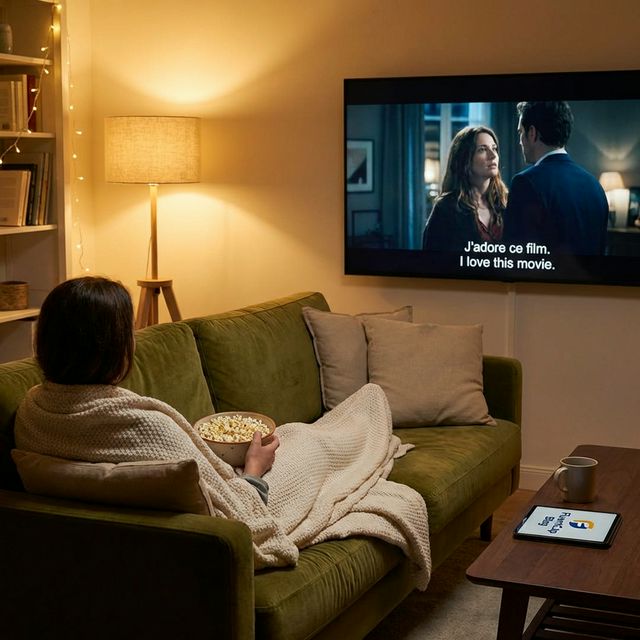
Watching a French film with French subtitles (intralingual subtitles) produces the strongest learning effects. The meta-analysis found that:
- Vocabulary form and meaning recognition improved significantly compared to no subtitles
- Effects were positive regardless of learner proficiency level
- Even keyword-only subtitles (highlighting key terms) showed strong results
Why it works: You hear native speech while simultaneously reading the same words. This creates a powerful connection between sounds and spelling — what linguists call phonological-orthographic mapping.
Native Language Subtitles (Good for Beginners)
Watching a French film with English subtitles (interlingual subtitles) is less effective for direct language acquisition but still valuable:
- Helps low-proficiency learners follow the story
- Provides meaning access that keeps engagement high
- Some research shows benefits for meaning recognition, especially with long-term exposure
No Subtitles (Advanced Testing)
For advanced learners, watching without subtitles serves as a comprehension test — a way to gauge how much you can understand from audio alone. This is not where most acquisition happens, but it builds confidence and identifies gaps.
The Research-Backed Progression
Based on the evidence from the University of East Anglia study and the NBER population data, the optimal progression is:
- Start: Native language subtitles (understand the story)
- Progress: Target language subtitles (connect sounds to text)
- Advance: Delayed captions or no subtitles (test comprehension)
- Master: Switch between modes based on content difficulty
A Practical Method for Learning From Films
Research shows the method matters as much as the exposure. Here is a structured approach that synthesizes findings from comprehensible input language learning methods and subtitle studies:
Step 1: Choose the Right Content
Select content where you can understand 60-80% without help. According to research on extensive reading and listening, comprehension below 60% overwhelms working memory and prevents acquisition; above 95% provides insufficient challenge.
Content selection tips:
- Familiar genres where you can predict context
- Shows with clear, everyday dialogue (avoid heavy slang or technical jargon initially)
- Content you genuinely enjoy — motivation is half the battle
Step 2: Watch With Target Language Subtitles
Once you understand the general story, switch to same-language subtitles. Focus on:
- Noticing recurring words and phrases
- Connecting the written form to the spoken sound
- Guessing meaning from context before checking translations
Step 3: Build Active Vocabulary
This is where passive watching becomes active learning:
- Pause for words that appear frequently or seem important
- Note expressions that native speakers use naturally
- Review your collected vocabulary between sessions
- Use new words in your own sentences within 24 hours
Step 4: Increase Difficulty Gradually
As comprehension improves, you can:
- Switch to content with faster dialogue
- Try delayed captions for active listening training
- Watch without subtitles and gauge understanding
- Explore different dialects and accents within the language
How FluentCap Turns Any Film Into a Language Lesson
The biggest limitation of film-based learning has always been subtitle availability. Streaming platforms offer subtitles in limited languages, and they cannot be customized for learning purposes.
FluentCap removes this barrier entirely:
Real-Time Subtitles for Any Source
Play any film on your computer — Netflix, YouTube, local video files, anything — and FluentCap generates real-time transcription in the original language. This gives you same-language subtitles for content that has no existing subtitles.
Live Translation
See the original language and your native language simultaneously. FluentCap's translation overlay lets you follow along without leaving the viewing experience — perfect for early-stage learners.
Delayed Captions for Active Listening
FluentCap can delay subtitles by 1-2 seconds, so you listen first and verify second. This transforms passive subtitle reading into active listening training.
See It In Action
Here is FluentCap generating real-time Spanish-to-English subtitles during a film:
Highlight and Save
With FluentCap's highlight feature, click any word in the live transcript to save it for later review. Build a personalized vocabulary list from real, contextual film dialogue.
Want to Test This Method Today?
Pick a movie you love, turn on same-language subtitles, and start noticing new words. If your streaming platform does not offer subtitles in the language you need, FluentCap generates real-time subtitles for any audio source — and it is free to get started. See all features or check pricing details to learn more.
Films Worth Starting With
The best film for language learning is the one you will actually finish. Here are research-informed recommendations:
English: "Friends" (clear everyday dialogue, repetitive vocabulary, 236 episodes of gradual exposure)
Spanish: "La Casa de Papel" (emotional context strengthens vocabulary encoding, clear theatrical delivery)
Korean: K-dramas like "Crash Landing on You" (clear enunciation, visual storytelling supports comprehension)
Japanese: Anime — we wrote a complete guide: Learn Japanese Through Anime Immersion
French: "Lupin" or "Call My Agent!" (contemporary Parisian French with cultural immersion)
Mistakes That Slow Your Progress
Reading Instead of Listening
If you catch yourself reading subtitles without paying attention to the audio, you are training reading — not listening. Solution: use delayed captions or turn subtitles off periodically.
Content That Is Too Hard
Choosing advanced content when you are a beginner leads to frustration, not acquisition. As British Council research notes, effective input must be comprehensible — understanding at least 60-80% of what you hear.
Skipping Active Review
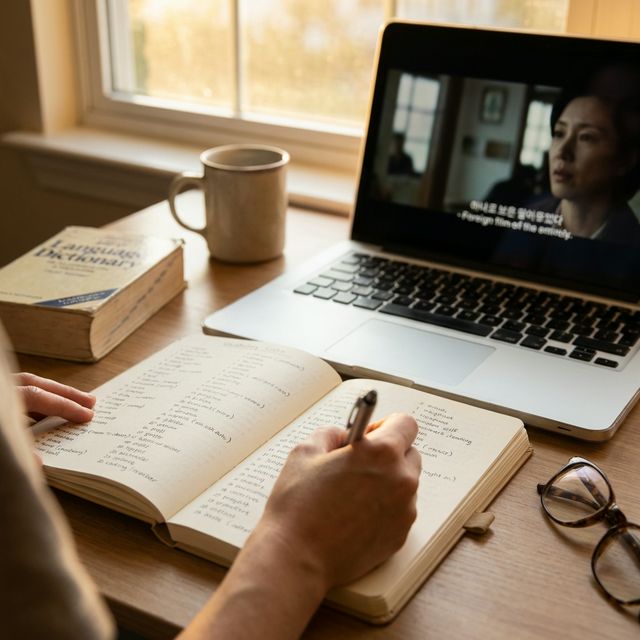
Passive watching alone produces slow gains. The research consistently shows that active noticing — pausing to examine words, noting patterns, reviewing vocabulary — dramatically accelerates acquisition compared to passive exposure.
One-Time Viewing
Re-watching content you have already seen in your native language is one of the most effective techniques. You already know the story, so your brain can focus entirely on the language. Research from the NBER paper suggests that repeated, long-term exposure creates the deepest language gains.
Thank You to Our Providers
FluentCap is made possible by speech-to-text providers who believe in accessible technology:
- Deepgram: $200 in free credits (~750 hours of transcription)
- AssemblyAI: $50 in free credits (~140 hours)
- Gladia: 10 free hours every month
- Shunya: $100 in free credits (~300 hours)
When your free credits run out, please support them. Their pricing is incredibly fair — just $0.15-0.40 per hour, which is 60-80% cheaper than subscription apps. They deserve your support for making language learning technology accessible to everyone.
Frequently Asked Questions
Does watching films really help you learn a language?
Yes. A 2019 NBER working paper found that countries using subtitling instead of dubbing showed significantly higher English proficiency at the population level. At the individual level, a meta-analysis from the University of East Anglia confirmed large positive effects of same-language subtitles on vocabulary learning. The evidence strongly supports film-based language learning when combined with active techniques.
How many hours of film watching does it take to see results?
Research varies, but most studies show noticeable vocabulary gains after 20-30 hours of active watching — meaning watching with same-language subtitles while actively noticing new words. The U.S. Foreign Service Institute estimates 600-2,200 total hours for language proficiency, and film watching can contribute meaningfully to this total.
Should I use subtitles in my native language or the target language?
The Journal of Specialised Translation meta-analysis found that target language subtitles (same language as the audio) produce the strongest vocabulary learning effects. Native language subtitles are useful for beginners who need to follow the story, but switch to target language subtitles as soon as possible for maximum acquisition benefit.
What is comprehensible input and why does it matter for film learning?
Comprehensible input is Stephen Krashen's hypothesis that we acquire language by understanding messages slightly above our current level. Films provide ideal comprehensible input because visual context — gestures, expressions, settings — helps you understand dialogue even when individual words are unfamiliar. This makes films more effective than audio-only content for most learners.
Can I really learn a language just by watching movies?
Films alone are unlikely to make you fully fluent, but they are one of the most effective components of a learning strategy. Research shows films excel at building vocabulary, improving listening comprehension, and developing cultural understanding. Combining film watching with speaking practice, active vocabulary review, and grammar exposure creates a comprehensive learning approach.
How is FluentCap different from Netflix subtitles?
Netflix offers pre-made subtitles in limited languages. FluentCap generates subtitles in real-time from any audio source — including content with no existing subtitles. It also offers live translation, delayed captions for active listening training, IPA pronunciation lookup, and a highlight feature for vocabulary collection. This makes any content on any platform into a language learning tool.
Scientific References
The research cited throughout this article:
- Bergeron, A., Honing, H., & Bhatt, M. P. (2019). "Media and Cultural Consumption: A Channel for Economic Development." NBER Working Paper No. 26561. National Bureau of Economic Research.
- Montero Perez, M. et al. "Intralingual subtitles and second language learning: A meta-analysis." Journal of Specialised Translation, Issue 41.
- University of East Anglia. Meta-analysis on intralingual subtitles and vocabulary acquisition. UEA ePrints #71935.
- Krashen, S. D. (1985). The Input Hypothesis: Issues and Implications. Longman. Author website.
- Paivio, A. (1986). Mental Representations: A Dual Coding Approach. Oxford University Press. ScienceDirect overview.
- ERIC. Review of comprehensible input research. EJ1145379. Education Resources Information Center.
Your Film Library Is Your Language Classroom
The research from NBER, the University of East Anglia, Stephen Krashen, and decades of applied linguistics converges on one conclusion: you can genuinely learn a language by watching movies — and the science proves it.
The content is already on your screen. Whether you choose Netflix, YouTube, or your favorite streaming platform, the key is to start with same-language subtitles and build from there.
Want a tool that generates real-time subtitles for any content? Give FluentCap a try — it is free to get started.
Related Articles
Explore more research-backed approaches to language learning:
- Comprehensible Input: The Natural Language Learning Method — The science behind natural language acquisition
- Delayed Captions: Train Your Listening Skills — Active listening technique that accelerates fluency
- Listen to Foreign Audiobooks with Subtitles — Extend learning beyond films
- Learn Japanese Through Anime Immersion — A dedicated guide for Japanese learners
- Pronunciation Practice with IPA & Speak — Master sounds with phonetic tools
- Watch Online Courses in Any Language — Access global education with AI subtitles
— FluentCap Team
Built to bring good things to the world.