Learn Languages with Foreign Podcasts
Over 500 million people listen to podcasts weekly — but most foreign podcasts have no subtitles. Here's how to add real-time captions to any podcast and turn passive listening into active language learning.
- 500 Million Listeners — Zero Subtitles
- Why Podcasts Are the Best Way to Learn Languages
- The Subtitle Gap: Why Foreign Podcasts Feel Impossible
- How to Learn Languages with Podcasts Using FluentCap
- What We Learned Testing FluentCap with Foreign Podcasts
- Best Platforms for Foreign Language Podcasts
- 5 Proven Techniques for Learning Languages Through Podcasts
- Thank You to Our Providers
- Frequently Asked Questions
500 Million Listeners — Zero Subtitles
Over 500 million people worldwide listen to podcasts weekly, and that number keeps growing. If you want to learn languages with podcasts, you're tapping into one of the most powerful — and most overlooked — resources available today.
Native speakers discussing real topics, using natural expressions, switching between formal and informal tones — foreign podcasts deliver the kind of authentic input that textbooks simply cannot replicate. Research from the Modern Language Journal consistently shows that exposure to natural speech is one of the strongest predictors of listening fluency.
The problem? Most podcasts have no subtitles. Without visual support, trying to follow a conversation in a language you're still learning feels like trying to catch water with your hands. Words blur together, slang flies past, and you're left guessing.
Until now. FluentCap adds real-time subtitles to any podcast playing on your computer — turning passive listening into active, effective language learning.
Why Podcasts Are the Best Way to Learn Languages
The Science Behind Podcast Learning
Research on comprehensible input — the foundation of natural language acquisition — tells us that we learn best when we understand messages slightly above our current level. Podcasts, combined with real-time subtitles, create exactly this environment.
According to studies published by the British Council, regular exposure to authentic listening materials significantly improves:
| Skill Area | How Podcasts Help |
|---|---|
| Listening comprehension | Natural speech patterns, varied accents, real conversations |
| Vocabulary acquisition | New words in meaningful, memorable contexts |
| Conversational fluency | Authentic expressions, idioms, and filler words |
| Cultural awareness | Understanding humor, social norms, current events |
| Pronunciation | Exposure to native rhythm, stress, and intonation |
Why Podcasts Beat Other Methods
Unlike movies or TV shows, podcasts are pure conversation. There are no visual distractions — your brain focuses entirely on the language. And unlike textbooks, podcasts use the language people actually speak.
| Method | Limitation |
|---|---|
| Textbooks | Artificial dialogues, outdated expressions |
| Language apps | Repetitive sentences, gamified but shallow |
| Movies/TV | Visual distractions, background noise, sound effects |
| Audiobooks | Formal narration, single voice, literary language |
Podcasts uniquely offer:
- Real conversations between native speakers
- Diverse accents and speaking styles
- Topics that match your interests
- New episodes constantly (fresh content!)
- Flexible listening — anywhere, anytime
The Subtitle Gap: Why Foreign Podcasts Feel Impossible
The Core Problem
Here's the frustrating reality for language learners who want to learn from authentic podcasts:
| Platform | Subtitles Available? |
|---|---|
| Spotify | ❌ No transcript for most podcasts |
| Apple Podcasts | ❌ Transcripts for select English shows only |
| YouTube Podcasts | ⚠️ Auto-captions exist but often inaccurate for non-English |
| Pocket Casts | ❌ No subtitle feature |
| Castbox | ❌ No built-in transcription |
Even when auto-captions exist (like YouTube), they are often:
- Inaccurate for non-English languages
- Missing punctuation and sentence boundaries
- Not available for live or newer content
- Impossible to translate inline
Why This Stops Learners
Without subtitles, language learners hit a wall:
- Words blur together — Native speakers don't pause between words like textbooks suggest
- Slang and idioms fly past — "C'est la galère" doesn't translate word-by-word
- Accents vary wildly — A podcast from Marseille sounds nothing like one from Paris
- Confidence drops — After 10 minutes of understanding nothing, most people give up
This is the exact affective filter that linguist Stephen Krashen warns about — when frustration rises, acquisition stops.
But what if you could see every word as it's spoken?
How to Learn Languages with Podcasts Using FluentCap
How It Works
FluentCap captures any audio playing on your computer and transcribes it in real-time. For podcast listeners learning languages, this means:
- Play any podcast — from Spotify, Apple Podcasts, YouTube, or any web player
- See real-time subtitles — words appear on screen as speakers talk
- Add translation — optional side-by-side translation in your native language
- Highlight vocabulary — save new words and expressions with one click
- Record sessions — capture audio for later review with FluentCap's recording feature
No browser extension needed. No special integrations. If you can hear it on your computer, FluentCap can transcribe it.
Your Personal Podcast Companion
| Feature | Why It Matters for Podcast Learning |
|---|---|
| Real-time text | See exactly what speakers are saying, even when they talk fast |
| Translation overlay | Understand meaning instantly when you're stuck |
| Highlight feature | Build a personal vocabulary list from real conversations |
| Delayed captions | Challenge your ears first with delayed captioning |
| Works with everything | Spotify, Apple, YouTube, browser-based players — all work |
What We Learned Testing FluentCap with Foreign Podcasts
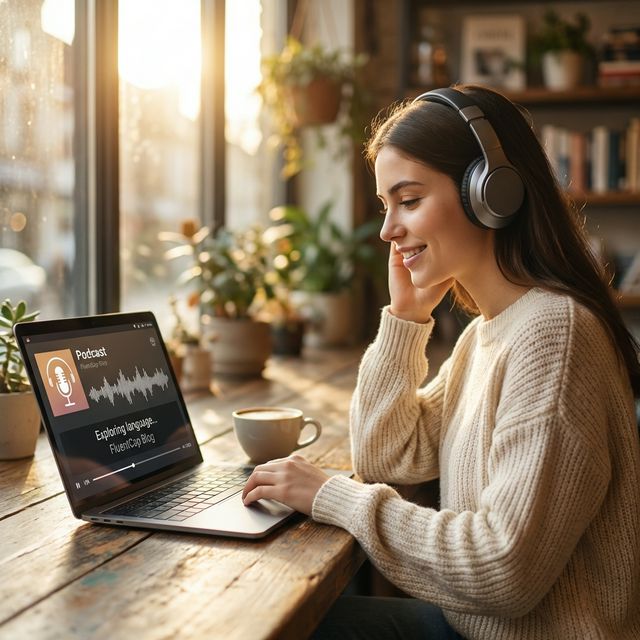
When we tested FluentCap with a 45-minute episode of France Inter (a popular French news podcast), even intermediate learners on our team reported understanding 30–40% more content on the first listen compared to listening without subtitles.
The biggest surprise? It wasn't just comprehension that improved — it was confidence. Learners said they felt more willing to keep listening, because the subtitles acted as a safety net. They could verify what they heard, catch words they missed, and stay engaged instead of giving up.
We saw similar results with NHK World Radio Japan (Japanese) and Deutsche Welle (German). Even for languages with non-Latin scripts, the real-time transcription gave learners an anchor point that made the audio feel manageable rather than overwhelming.
This matches what research on multimodal learning has consistently shown: combining auditory and visual input leads to deeper processing and better long-term retention than either channel alone.
Best Platforms for Foreign Language Podcasts
One of the best things about podcast learning is the sheer variety of content available. Here are some excellent starting points by language:
Spanish
- Radio Ambulante (NPR) — Latin American stories, clear narration
- Hoy Hablamos — Daily Spanish learning podcast
- TED en Español — Inspiring talks in Spanish
French
- InnerFrench — Intermediate French, clear and slow
- France Inter — Current events, interviews, culture
- Transfert (Slate.fr) — Personal stories, emotional narratives
Japanese
- NHK World Radio Japan — News in clear Japanese
- Nihongo con Teppei — Beginner-friendly Japanese conversations
- Rebuild.fm — Tech discussions in Japanese
German
- Slow German — News and culture at a learner-friendly pace
- Deutsche Welle — Comprehensive German content
- Gemischtes Hack — Popular comedy podcast
Korean
- Talk To Me In Korean — Structured learning content
- SBS Korean — Australian-Korean news and culture
- 다락방 (Darakbang) — Natural Korean conversations
Multilingual Discovery
- Spotify — Browse by language in the podcast section
- Apple Podcasts — Filter charts by country/language
- YouTube — Search "[language] podcast" for endless options
All of these work seamlessly with FluentCap — just play them on your computer and see real-time subtitles appear automatically.
5 Proven Techniques for Learning Languages Through Podcasts
1. The "Subtitled First Listen" Method
On your first listen, keep FluentCap subtitles on with translation enabled. Don't pause. Let the conversation flow and use the visual support to follow along. This builds familiarity with the topic and key vocabulary.
2. The Shadow Technique
Listen to a segment, then repeat what you heard — mimicking the speaker's rhythm, intonation, and pronunciation. With FluentCap's subtitles, you can see exactly what was said and practice getting it right.
3. Graded Difficulty Progression
Start with podcasts designed for learners (like InnerFrench or Slow German), then graduate to native content. Use FluentCap's translation less and less as you improve. Eventually, try the delayed captions feature to truly test your ears.
4. The Highlight & Review Cycle
As you listen, use FluentCap's Highlight feature to save unfamiliar words and expressions. After each session, review your highlights. This turns passive listening into active vocabulary building.
5. The Immersion Schedule
According to the U.S. Foreign Service Institute, reaching conversational proficiency requires 600-750 hours of study for most languages. Podcasts let you accumulate those hours naturally:
| Daily Time | Weekly Total | Yearly Total |
|---|---|---|
| 20 minutes | 2.3 hours | ~120 hours |
| 30 minutes | 3.5 hours | ~182 hours |
| 1 hour | 7 hours | ~365 hours |
Even 20 minutes daily with a foreign podcast adds up to 120 hours per year of authentic language exposure. That's significant progress — especially when combined with subtitles that make every minute count.
Thank You to Our Providers
FluentCap's real-time podcast transcription is made possible by incredible speech-to-text providers who are advancing the boundaries of language technology:
- Deepgram: Offers $200 in free credits (~750 hours of transcription)
- AssemblyAI: Provides $50 in free credits (~140 hours)
- Gladia: Gives 10 free hours every month
- Shunya: Offers $100 in free credits (~300 hours)
These providers make high-quality multilingual transcription accessible to language learners everywhere. When your free credits run out, we encourage you to support them. Their pricing is incredibly fair — just $0.15-0.40 per hour, which is 60-80% cheaper than traditional subscription apps.
They deserve your support for making this technology available to the world.
Frequently Asked Questions
Is listening to podcasts effective for language learning?
Yes. Podcasts provide authentic input, real accents, and natural speech patterns — all essential for developing listening comprehension and fluency. Research from Cambridge University confirms that authentic materials significantly outperform textbook audio for long-term acquisition.
Can you learn a language just by listening to podcasts?
Listening alone helps, but combining it with subtitles dramatically improves results. When you can see and hear words simultaneously, your brain forms stronger connections. FluentCap adds this visual layer to any podcast automatically.
How many hours of podcasts do you need to learn a language?
The U.S. Foreign Service Institute estimates 600-750 hours for most languages. Listening to just 30 minutes of podcasts daily with subtitles adds up to 182 hours per year — a meaningful portion of your learning journey.
Can FluentCap transcribe podcasts in any language?
Yes! FluentCap supports real-time transcription in over 30 languages including Spanish, French, German, Japanese, Korean, Chinese, Portuguese, Italian, Arabic, Hindi, and many more. Accuracy is excellent for clear podcast audio and improves with high-quality recordings.
Do I need a special app or browser extension?
No. FluentCap is a standalone desktop application for macOS. It captures audio at the system level, which means it works with any podcast app or website — Spotify, Apple Podcasts, YouTube, or any browser-based player. No extensions or plugins needed.
Can I use FluentCap with Spotify podcasts?
Absolutely. Open Spotify on your computer (desktop app or web player), play any podcast, and FluentCap will transcribe it in real-time. This works for every podcast on Spotify, regardless of language.
How accurate is the transcription for foreign language podcasts?
Accuracy depends on the audio quality and speaking clarity. For well-produced podcasts with clear narration, expect 90-95%+ accuracy. Casual conversations with background noise or multiple speakers may have slightly lower accuracy, but still provide highly useful subtitles for learning.
Can I save new vocabulary from podcasts?
Yes! FluentCap includes a Highlight feature that lets you mark and save unfamiliar words or phrases during listening. You can review your highlights later and export them for flashcard apps or personal vocabulary lists.
Is FluentCap free to use with podcasts?
FluentCap itself is free forever. You only pay the speech-to-text providers directly for their transcription service. Providers offer hundreds of hours of free credits to get started. After that, rates are just $0.15-0.40 per hour — which means a 1-hour podcast episode costs less than a cup of coffee to transcribe.
Ready to Learn Languages with Podcasts?
The world's most fascinating conversations are happening right now — in Spanish, French, Japanese, Korean, German, and dozens of other languages. Comedy shows that make entire countries laugh. Interview podcasts with thought leaders. True crime stories that keep millions on the edge of their seats.
Download FluentCap and add real-time subtitles to any foreign podcast. Every episode becomes a language lesson — no special setup, no subscriptions, no limits on what you can listen to.
You don't need to wait for subtitles that may never come. You don't need to find "learner-friendly" content forever. When you're ready, dive into the real thing — and let FluentCap help you learn languages with podcasts you actually enjoy.
We built FluentCap because we believe language should never be a barrier to learning, connecting, or discovering new perspectives. Your next favorite podcast might be in a language you're still learning. Give it a try — now you can finally understand it.
Related Articles
More ways to use FluentCap for language learning:
- Foreign Audiobooks with Live Subtitles — Apply the same technique to audiobooks from Audible, Spotify & more
- Delayed Captions for Listening Training — Challenge your ears with timed caption delay
- Comprehensible Input: The Science-Backed Method — The research behind immersion learning
- Free Transcription: 750+ Hours Available — Get started with generous provider credits
— FluentCap Team
Built to bring good things to the world.