Pronunciation Practice with IPA & Speak
Mispronunciation is the hidden wall between you and real comprehension. If you pronounce a word wrong, you will not recognize it when a native speaker says it. FluentCap IPA and Speak tools fix this.
- Why Mispronunciation Kills Your Listening Skills
- What Is the International Phonetic Alphabet (IPA)?
- How FluentCap IPA Lookup Works
- Speak: Hear the Correct Pronunciation Instantly
- The Pronunciation-Listening-Understanding Chain
- Practical Guide: Using IPA and Speak for Language Learning
- Supported Languages for IPA Lookup
- Thank You to Our Providers
- Frequently Asked Questions
Why Mispronunciation Kills Your Listening Skills
You studied the word. You memorized the meaning. You used it in a sentence. But when a native speaker says it at natural speed, you do not recognize it at all.
This is one of the most frustrating experiences in language learning — and the hidden cause is almost always pronunciation.
Research published in Studies in Second Language Acquisition has consistently shown that a learner's phonological awareness directly impacts their listening comprehension. When you learn a word with an incorrect pronunciation, your brain stores a wrong sound model for that word. Later, when you hear the correct pronunciation from a native speaker, your brain fails to match what it hears to what it has stored.
The result: you hear the word but do not understand it.
Consider these common examples in English:
| You Say | Native Says | IPA | The Problem |
|---|---|---|---|
| "tink" | "think" | /θɪŋk/ | Missing the /θ/ (th) sound |
| "bed" | "bad" | /bæd/ | Confusing /e/ with /æ/ |
| "sheet" | "sheet" vs "ship" | /ʃiːt/ vs /ʃɪp/ | Missing vowel length distinction |
| "rice" | "lice" | /raɪs/ vs /laɪs/ | Confusing /r/ with /l/ |
A 2025 review of pronunciation error research confirmed that errors in segmental sounds — individual consonants and vowels — lead directly to semantic confusion. If you cannot produce the difference between "think" and "sink," you cannot reliably hear it either.
This is not just an English problem. Every language has sounds that challenge non-native speakers. Japanese learners struggle with pitch accent. French learners struggle with nasal vowels. Korean learners struggle with tense consonants.
The fix is not more vocabulary lists. The fix is better pronunciation awareness.
What Is the International Phonetic Alphabet (IPA)?
The International Phonetic Alphabet is a standardized system where each symbol represents exactly one sound. Unlike regular spelling, IPA is never ambiguous.
Consider the English letter combination "ough" — it produces different sounds in "through" (/θruː/), "though" (/ðoʊ/), "tough" (/tʌf/), and "cough" (/kɒf/). Four completely different pronunciations from the same spelling.
IPA eliminates this confusion. Every symbol maps to one and only one sound:
| IPA Symbol | Sound | Example |
|---|---|---|
| /θ/ | voiceless "th" | think |
| /ð/ | voiced "th" | this |
| /æ/ | open front vowel | cat |
| /ʃ/ | "sh" sound | ship |
| /iː/ | long "ee" | see |
| /ɪ/ | short "i" | sit |
The British Council's pronunciation resources emphasize that understanding IPA helps learners become independent — you can look up any word in a dictionary and know exactly how to pronounce it, even if you have never heard it before.
A 2024 study published in ERIC found that explicit IPA instruction for EFL learners in Vietnam led to significant improvements in pronunciation accuracy and was positively received by learners. The researchers concluded that IPA helps learners "visualize complex sound codes" and increases their awareness of sound features in the target language.
You do not need to memorize every IPA symbol. Even learning the symbols for sounds that do not exist in your native language makes a massive difference.
How FluentCap IPA Lookup Works
FluentCap includes a built-in offline IPA dictionary that covers over 25 languages. Here is how it works:
- Hover over any word in your live transcript — it highlights with a soft background so you know exactly what you are selecting
- Click the word — a context menu appears instantly
- IPA pronunciation is displayed automatically at the very top of the menu
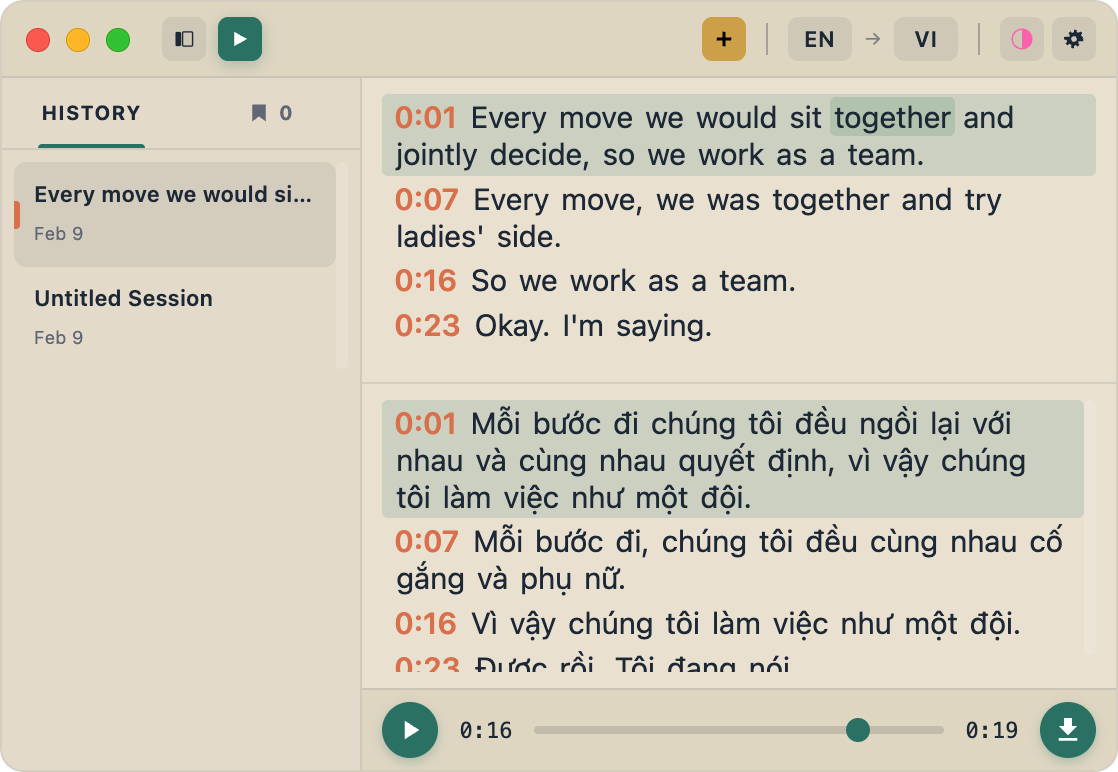
The lookup is completely offline. FluentCap bundles phonetic dictionaries for each supported language, so there is no internet request, no delay, and no usage limit. The dictionaries are lazy-loaded — they only load into memory when you first use a language, keeping the app lightweight.
For example, selecting the word "together" in an English transcript instantly shows its IPA transcription at the top of the context menu:
/tə'ɡɛðɚ/
You can see immediately that the "th" in "together" is actually the voiced /ð/ sound, not the voiceless /θ/. And the final "er" is actually the rhotic schwa /ɚ/. These subtle details are exactly what IPA reveals.
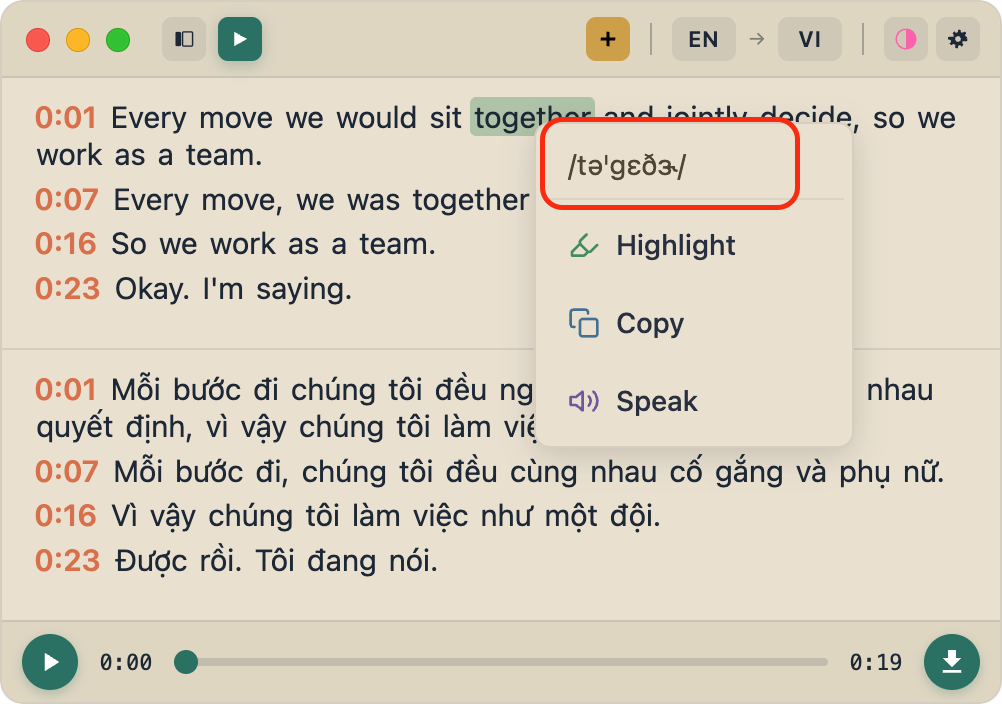
The context menu also handles multi-word selections. Select a full phrase and see the IPA transcription for each word, helping you understand connected speech patterns.
Speak: Hear the Correct Pronunciation Instantly
Seeing the IPA is powerful. But hearing the correct sound takes it to another level.
FluentCap's Speak button is right next to the IPA display in the context menu. One click and you hear the selected text pronounced clearly in the correct language and accent.
Here is how it works under the hood:
- Uses your system's built-in text-to-speech engine (Web Speech API)
- Automatically sets the correct language based on your transcript's source language
- Plays at a slightly reduced speed (0.9x) for clarity
- Works with any language your operating system supports
The workflow is simple:
- Hear something in the transcript you are not sure about
- Select the word or phrase
- See the IPA transcription — now you know what sounds to expect
- Click Speak — hear the native pronunciation
- Repeat after it — shadow the pronunciation
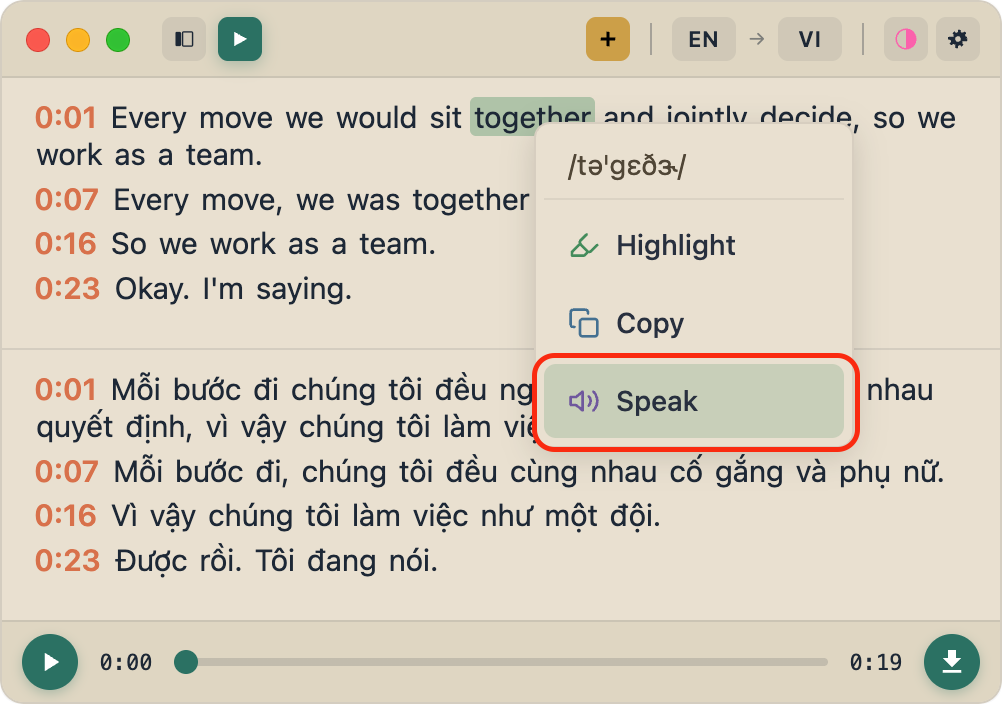
This combination of visual phonetic representation (IPA) and auditory confirmation (Speak) creates a powerful feedback loop that textbooks simply cannot provide.
The Pronunciation-Listening-Understanding Chain
Language comprehension is not a single skill. It is a chain, and every link matters:
Pronunciation → Listening → Understanding
If the first link is broken, everything downstream breaks too.
A 2024 study on ResearchGate demonstrated a statistically significant correlation between pronunciation drills and improved listening comprehension. Students who practiced pronunciation regularly showed measurably better scores on listening tests — not because they were listening more, but because they had built accurate sound models in their brains.
Here is how FluentCap strengthens every link in this chain:
| Chain Link | The Problem | FluentCap Solution |
|---|---|---|
| Pronunciation | You learned the word with wrong sounds | IPA shows exact phonetic representation |
| Listening | Brain cannot match what it hears to stored model | Speak lets you hear and rehearse the correct sound |
| Understanding | Meaning is lost because sound was not recognized | Real-time transcript confirms what was said |
Research from holistic pronunciation training studies shows that integrating both segmental training (individual sounds, which IPA provides) and suprasegmental training (stress and intonation, which Speak provides) yields significantly better listening comprehension outcomes than either approach alone.
FluentCap naturally provides both. IPA gives you the segments. Speak gives you the rhythm and intonation. The live transcript gives you the context. Together, they close the loop.
Practical Guide: Using IPA and Speak for Language Learning
Here is a step-by-step method to build pronunciation mastery using FluentCap:
Step 1: Immerse in Real Audio
Start FluentCap and play content in your target language — a podcast, a foreign film, a lecture, or a conversation. Let the transcript run in real-time.
Step 2: Identify Unknown Words
When you see a word in the transcript that you do not know — or worse, a word you think you know but might be pronouncing wrong — select it.
Step 3: Read the IPA
The IPA transcription appears instantly at the top of the context menu. Look for sounds that differ from your expectations:
- Are there sounds that do not exist in your native language?
- Is the vowel longer or shorter than you thought?
- Is the stress on a different syllable?
Step 4: Listen With Speak
Click the Speak button. Listen carefully. Compare what you hear to what you expected based on the IPA. Notice the differences.
Step 5: Shadow and Repeat
Say the word out loud immediately after Speak plays it. Try to match the sounds as closely as possible. This technique — called shadowing — is one of the most effective methods for pronunciation improvement.
Step 6: Save and Review
Use FluentCap's highlight feature to save the word for later review. Build a collection of words grouped by their challenging sounds.
Bonus Tip: Combine With Delayed Captions
For advanced practice, use FluentCap's delayed captions mode. Listen to the audio first, try to identify words by their sounds, then check the transcript after a 1.5-second delay. When you encounter a word you missed, use IPA and Speak to understand exactly which sound tripped you up.
Supported Languages for IPA Lookup
FluentCap's IPA dictionary supports over 25 languages, all available offline:
| Language | Variants | Language | Variants |
|---|---|---|---|
| 🇺🇸 English | US, UK | 🇰🇷 Korean | Standard |
| 🇫🇷 French | France, Quebec | 🇻🇳 Vietnamese | Northern |
| 🇩🇪 German | Standard | 🇸🇦 Arabic | Standard |
| 🇪🇸 Spanish | Spain, Mexico | 🇫🇮 Finnish | Standard |
| 🇵🇹 Portuguese | Brazil | 🇳🇱 Dutch | Standard |
| 🇯🇵 Japanese | Standard | 🇷🇴 Romanian | Standard |
| 🇨🇳 Chinese | Simplified, Traditional, Cantonese | 🇸🇪 Swedish | Standard |
| 🇳🇴 Norwegian | Bokmål | 🇮🇸 Icelandic | Standard |
| 🇰🇭 Khmer | Standard | 🇮🇷 Persian | Standard |
| 🇰🇪 Swahili | Standard | 🇲🇾 Malay | Standard |
Here is an example of IPA working with Vietnamese — selecting the word "quyết" instantly shows its phonetic transcription:
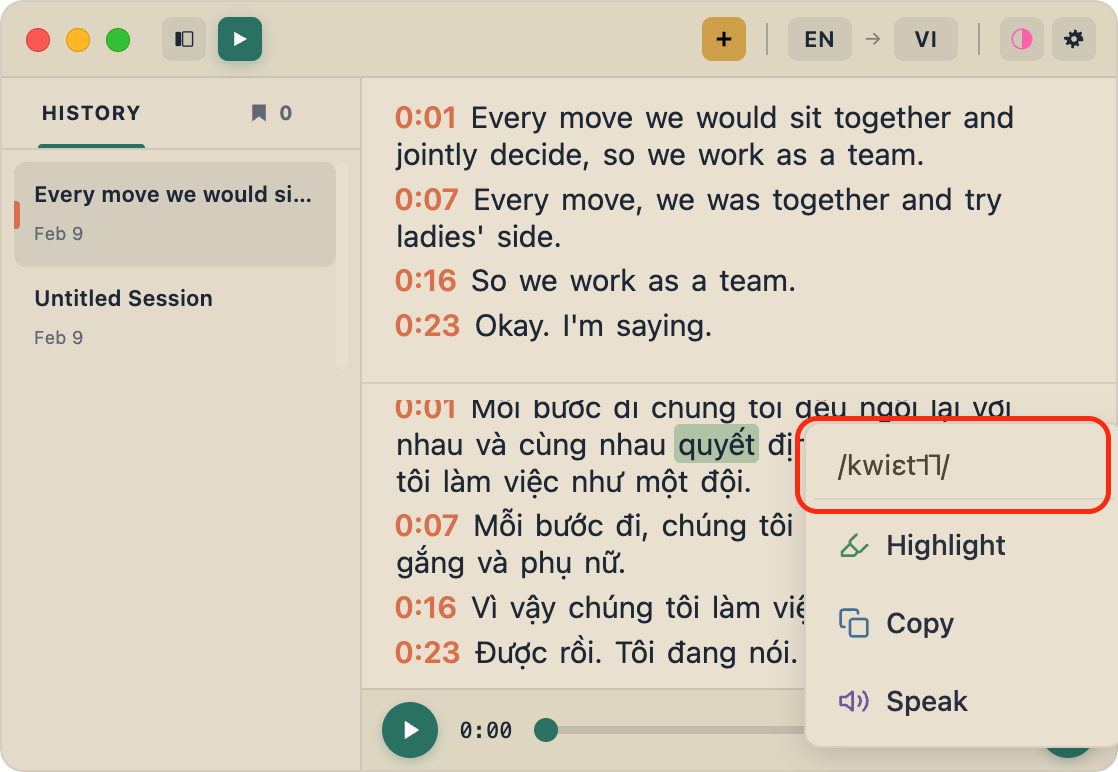
Every dictionary is loaded on demand and cached in memory. No internet connection required. No subscription. No limits.
The Speak feature extends even further — it works with any language supported by your operating system's text-to-speech engine, which typically includes 50+ languages on modern macOS and Windows systems.
Thank You to Our Providers
FluentCap's real-time transcription is powered by speech-to-text providers who make language learning accessible to everyone:
- Deepgram: $200 in free credits (~750 hours of transcription)
- AssemblyAI: $50 in free credits (~140 hours)
- Gladia: 10 free hours every month
- Shunya: $100 in free credits (~300 hours)
These providers make it possible to transcribe audio in dozens of languages in real-time. When your free credits run out, please support them — their pricing is incredibly fair at just $0.15-0.40 per hour, which is 60-80% cheaper than traditional subscription apps. They deserve your support for making this technology accessible to everyone.
Frequently Asked Questions
Is the IPA feature free?
Yes. FluentCap's IPA lookup is completely free and works offline. The phonetic dictionaries are bundled with the app — no subscription, no API key, and no internet connection required. You can look up pronunciation for any word in any supported language at no cost.
Does FluentCap's Speak work offline?
The Speak feature uses your system's built-in text-to-speech engine, which works offline for most languages. However, some operating systems may require an internet connection for certain language voices. On macOS and Windows, the most common languages (English, French, German, Spanish, Japanese, Korean, Chinese) have offline voices pre-installed.
How many languages support IPA lookup?
FluentCap currently supports IPA lookup for over 25 languages, including English (US and UK), French, German, Spanish, Portuguese, Japanese, Korean, Chinese (Simplified, Traditional, and Cantonese), Vietnamese, Arabic, Finnish, Dutch, Romanian, Swedish, Norwegian, Icelandic, Khmer, Persian, Swahili, and Malay. More languages are being added regularly.
Can I use this to practice pronunciation for a language exam?
Absolutely. Whether you are preparing for IELTS, TOEFL, JLPT, DELF, or any other language proficiency test, FluentCap's IPA and Speak tools help you identify and correct pronunciation weaknesses. Select words from real audio content, study their IPA transcription, and practice with the Speak button until you can reproduce the sounds accurately.
What is the difference between IPA and regular phonetics?
Regular phonetic spellings (like "bahn-JOOR" for "bonjour") are informal and inconsistent — different books use different systems. The International Phonetic Alphabet is a universal, standardized system used by linguists worldwide. Each IPA symbol represents exactly one sound, eliminating all ambiguity. FluentCap uses the full IPA standard for maximum accuracy.
Pronunciation Is the Foundation of Language
Every language skill — listening, speaking, reading, comprehension — is built on a foundation of accurate sound recognition. When that foundation has cracks, everything above it is unstable.
FluentCap's IPA and Speak tools give you the ability to see the exact sounds of any word and hear them pronounced correctly — all within the flow of real content you are already consuming. No separate app. No extra step. Just select a word and discover its true pronunciation.
When you are ready to stop guessing and start hearing clearly, give FluentCap a try.
Related Articles
Explore more ways to improve your language skills:
- Comprehensible Input: Learn English Naturally — The science behind immersion learning
- Delayed Captions: Train Your Listening — Active listening techniques for faster progress
- FluentCap Highlight Feature Guide — Save and organize vocabulary from live transcripts
- Learn Languages by Watching Movies — The science behind learning from visual media
- Foreign Podcast Language Learning — Turn podcasts into pronunciation practice
— FluentCap Team
Built to bring good things to the world.