Learn Language Before Travel: Virtual Immersion at Home
Transform your pre-trip preparation with virtual language immersion. Learn to understand foreign news, cultural content, and local media before you even board the plane.
- The Missing Piece in Every Travel Guide
- Why Virtual Immersion Works Before You Travel
- The Best Content for Pre-Trip Language Preparation
- How FluentCap Transforms Your Travel Preparation
- Your 4-Week Pre-Trip Immersion Plan
- Cultural Preparation Beyond Language
- Thank You to Our Providers
- Frequently Asked Questions
The Missing Piece in Every Travel Guide
You've researched the best restaurants. You've bookmarked the must-see attractions. You've even downloaded an offline map. But when you arrive in Japan, France, or South Korea, something feels wrong.
The language barrier hits you harder than expected.
You can order food by pointing at pictures. You can navigate with translation apps. But you miss everything else — the conversations around you, the announcements at train stations, the jokes that make locals laugh, the cultural nuances that transform tourists into travelers.
What if you could immerse yourself in your destination's language weeks before your trip?
This isn't about memorizing phrasebook sentences. It's about training your brain to recognize sounds, understand context, and absorb cultural rhythms — all from your desk at home. Linguist Stephen Krashen's Comprehensible Input Hypothesis suggests that we acquire language when we understand messages just beyond our current level — and watching authentic media provides exactly that kind of meaningful, contextualized input. Research from BYU's study abroad program confirms that pre-departure language exposure significantly improves outcomes upon arrival. If you're interested in learning a language through media, the science supports starting before you travel.
Why Virtual Immersion Works Before You Travel
Your Brain Needs Time to Adjust
Language processing isn't instant. When you hear an unfamiliar language, your brain works overtime to:
- Segment continuous speech into individual words
- Match sounds to meanings
- Recognize intonation patterns
- Process cultural context
This takes time. Arriving in Tokyo without any Japanese listening practice means your brain spends the first days just adjusting to the sounds. But with pre-trip immersion, you arrive with a head start.
Research-Backed Benefits
Studies on language immersion preparation show remarkable benefits for travelers:
| Preparation | Impact |
|---|---|
| Daily media exposure | Faster language recognition upon arrival |
| Cultural content | Better understanding of social norms and customs |
| News consumption | Awareness of current events and local concerns |
| Livestream watching | Real-time, authentic language patterns |
According to research published by ERIC (Education Resources Information Center), reaching at least an A2 (high beginner) level before traveling significantly improves immersion outcomes. Even if you don't achieve that level, every hour of listening practice makes a difference — what Krashen calls "narrowing the affective filter" through low-stress comprehensible input.
The Desktop Advantage
You might think, "I'll practice when I get there." But real-world immersion is overwhelming. You're tired from travel, navigating unfamiliar places, and processing everything at once.
Pre-trip preparation from your desktop gives you:
- Controlled environment with pause and replay
- Time to look up unfamiliar words
- No social pressure to respond immediately
- Comfort to make mistakes without embarrassment
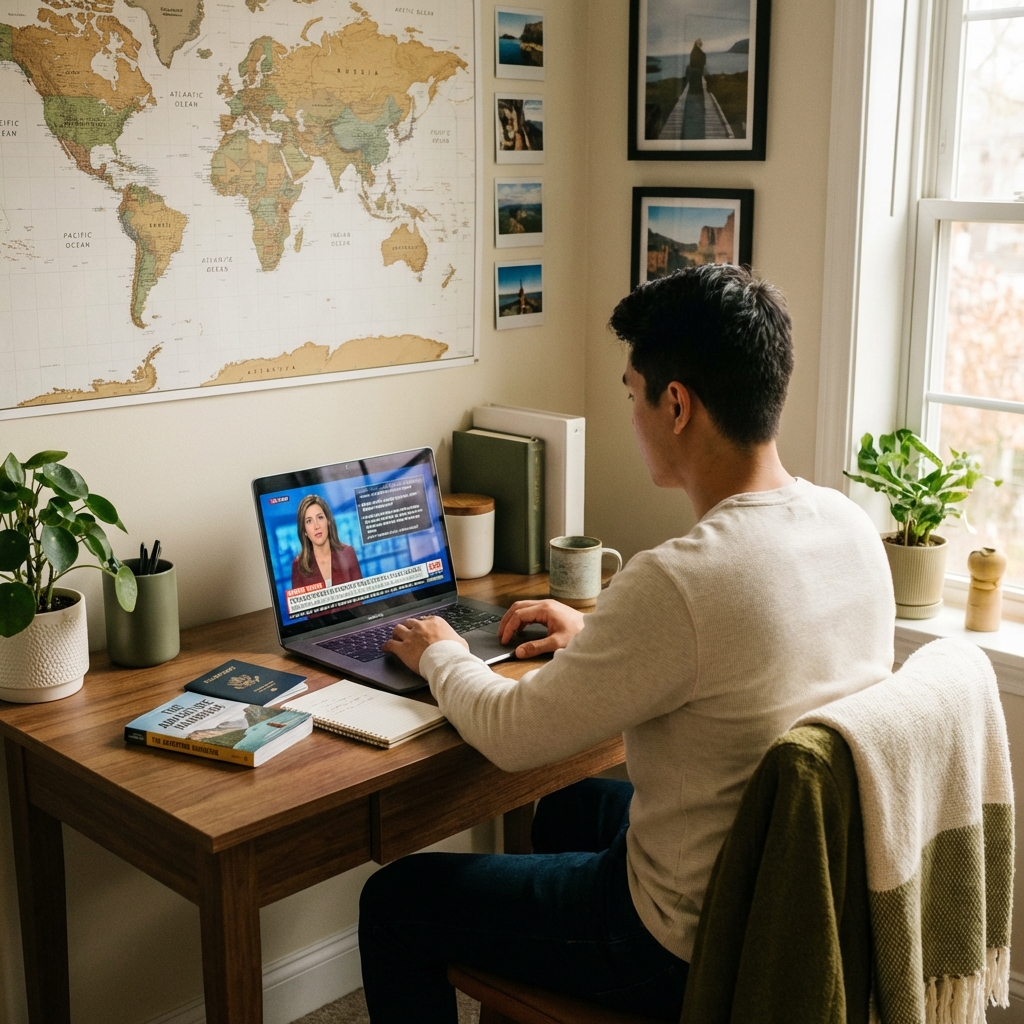
The Best Content for Pre-Trip Language Preparation
Local News Broadcasts
Nothing connects you to a destination like its news. You'll learn about:
- Current events and local concerns
- Weather patterns and seasonal activities
- Cultural celebrations and holidays
- Economic and social context
Recommended sources by destination:
| Destination | News Sources |
|---|---|
| Japan | NHK World, Fuji TV, TV Asahi livestreams |
| South Korea | KBS, MBC, Arirang News |
| France | France 24, LCI, BFMTV |
| Spain | RTVE, Antena 3, Euronews Spanish |
| Germany | Deutsche Welle, ARD, ZDF |
| Italy | RAI, Sky TG24, La7 |
Travel Vlogs and Documentaries
See your destination through local eyes. Travel documentaries and vlogs offer:
- Real conversations in authentic settings
- Cultural insights beyond tourist areas
- Practical vocabulary for daily situations
- Visual context for language learning
Livestreams and Real-Time Content
Perhaps the most powerful preparation tool. Livestreams from your destination show you:
- How people actually speak in casual settings
- Current trends and cultural moments
- Real-time weather and atmosphere
- Unscripted, natural language use
Podcasts from Local Creators
For listening practice during commutes or workouts:
- Local perspectives on culture and daily life
- Variety of speech patterns and accents
- Topics ranging from casual to professional
- Often available with transcripts
How FluentCap Transforms Your Travel Preparation
Real-Time Transcription of Any Content
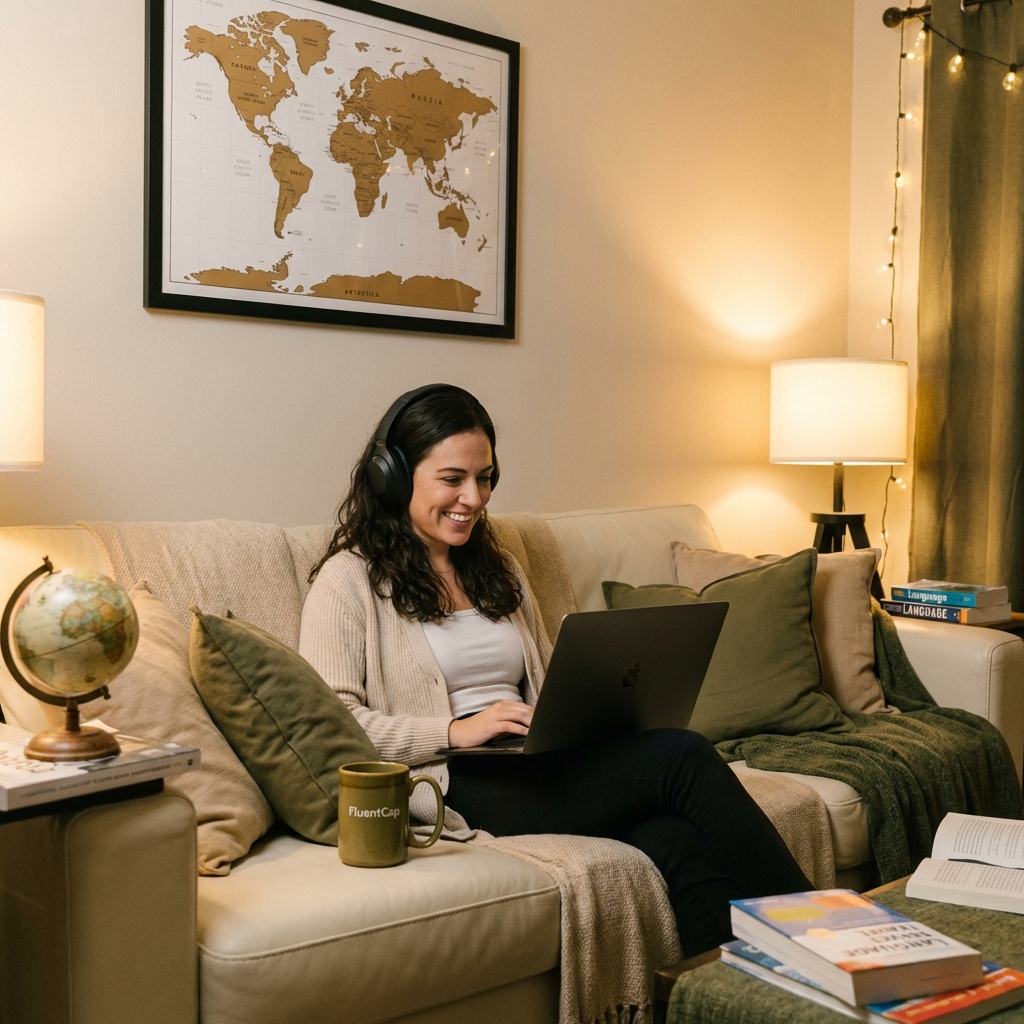
FluentCap captures audio from any source on your computer — news sites, YouTube streams, podcast players, video platforms — and transcribes it in real-time. For travel preparation, this means:
- Understand local news without waiting for translations
- Catch every word in fast-paced livestreams
- Learn pronunciation by seeing text match spoken audio
- Build vocabulary from authentic, current content
Translation When You Need It
Toggle between transcription-only mode (advanced practice) and side-by-side translation (comprehension support). As your preparation progresses, gradually reduce your reliance on translations.
Any Language, Any Destination
Planning a trip to Thailand? Portugal? Morocco? FluentCap works with multiple speech-to-text providers supporting dozens of languages. Your destination is covered.
Study at Your Own Pace
Unlike classroom courses locked to schedules, FluentCap lets you:
- Pause confusing segments
- Replay interesting phrases
- Take notes without missing content
- Study early morning or late night
Your 4-Week Pre-Trip Immersion Plan
Week 1: Passive Listening Phase
Goal: Acclimate your ear to the language's rhythm and sounds
Daily activities (30-60 minutes):
- Watch local news broadcasts with translation on
- Focus on recognizing common words (greetings, numbers, days)
- Note recurring phrases you hear often
- Don't stress about understanding everything
Content recommendation: Children's shows, slow news programs, simple vlogs
Week 2: Active Listening Phase
Goal: Start connecting sounds to meanings
Daily activities (45-60 minutes):
- Watch content with transcription visible
- Pause to look up new vocabulary
- Create a travel-specific word list
- Practice pronunciation by repeating phrases
Content recommendation: Travel vlogs, cultural documentaries, interview shows
Week 3: Contextual Learning Phase
Goal: Learn vocabulary specific to your trip
Daily activities (60 minutes):
- Focus on content related to your itinerary
- Taking a cooking class? Watch cooking shows
- Visiting temples? Watch cultural/religious content
- Navigating transit? Watch transportation guides
- Build phrase sheets for common situations:
- Ordering food
- Asking for directions
- Shopping interactions
- Emergency phrases
Content recommendation: Topic-specific content, local review shows, practical guides
Week 4: Immersion Simulation Phase
Goal: Test your comprehension and build confidence
Daily activities (60+ minutes):
- Watch content with translation off (transcription only)
- Take notes in the target language when possible
- Practice responding to what you hear (even alone)
- Watch "day in the life" vlogs to simulate arrival
Content recommendation: Livestreams, unscripted vlogs, reality content, news without subtitles
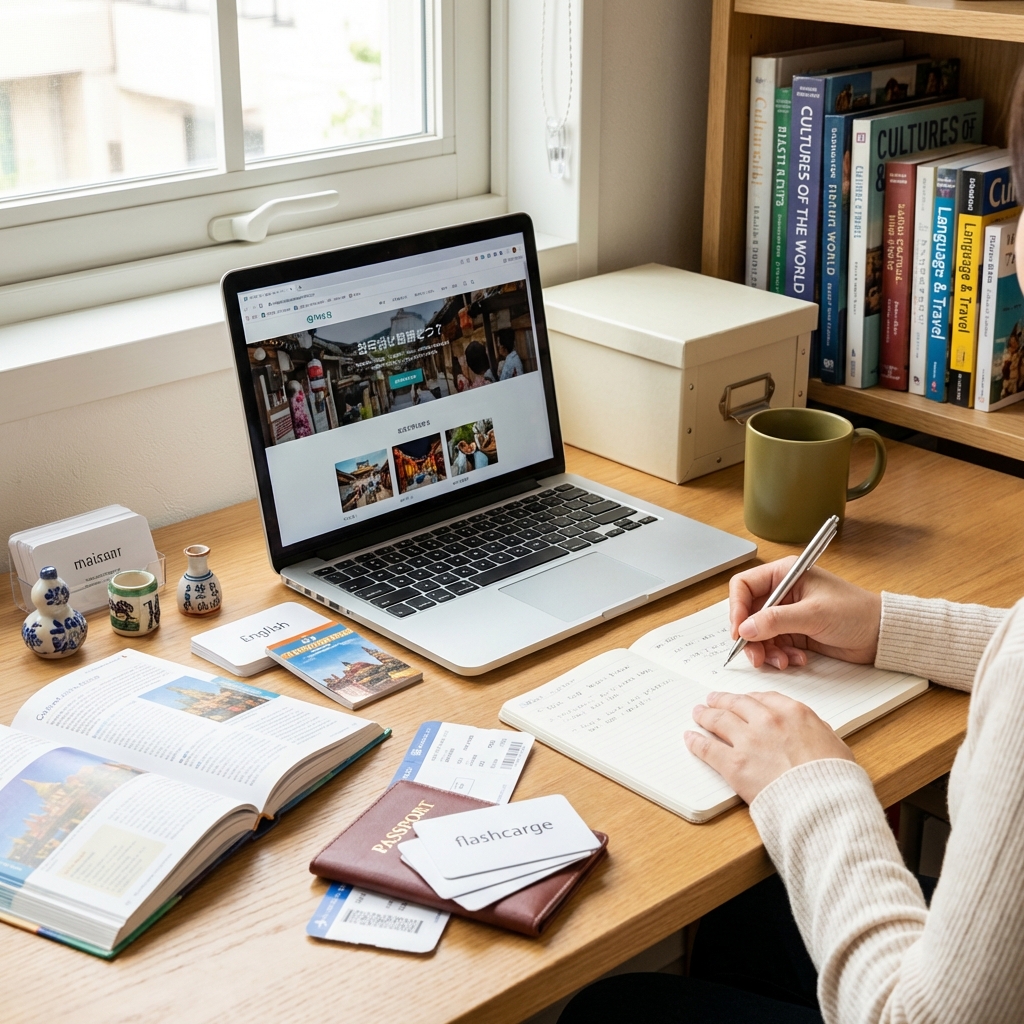
Cultural Preparation Beyond Language
Understanding Non-Verbal Communication
Intercultural communication research emphasizes that language is just part of communication — studies suggest over 70% of meaning is conveyed non-verbally. By watching foreign movies with subtitles, you can observe how people move, gesture, and interact in authentic contexts. Pay attention to:
| Culture | Non-Verbal Norms |
|---|---|
| Japan | Bowing depth indicates respect level, limited eye contact with strangers |
| Middle East | Same-gender physical affection common, right hand for greetings |
| Latin America | Close personal space, expressive gestures, warm physical greetings |
| Nordic countries | Large personal space, minimal small talk, direct communication |
Learning Local Customs Through Media
As you watch local content, observe:
- Greetings: How do people say hello? Bow, handshake, kiss?
- Dining etiquette: Where do hands go? What's rude?
- Tipping culture: Does it exist? How much?
- Dress codes: What's appropriate where?
- Religious customs: What should visitors respect?
Current Events Awareness
Knowing what's happening in your destination shows respect and creates connection points:
- Major sports events or cultural moments
- Political situations affecting daily life
- Economic context (is it a good time for tourists?)
- Weather patterns and natural events
Real Traveler Scenarios
Scenario 1: The Restaurant Experience
Without preparation: You point at menu items, nod at everything, receive food you didn't expect, and can't communicate dietary needs.
With 4 weeks of immersion: You recognize menu vocabulary, understand the server's recommendations, specify your preferences, and catch the genuine "thank you" that locals use versus the tourist version.
Scenario 2: Getting Lost
Without preparation: You show your phone's translation to strangers, hope they understand, and feel stressed when directions come too fast.
With 4 weeks of immersion: You ask for help using phrases you've heard dozens of times, understand "turn left at the station," recognize landmarks by their sounds, and feel the accomplishment of real communication.
Scenario 3: Serendipitous Connections
Without preparation: You stay in tourist bubbles, miss local jokes, and experience the destination as an observer.
With 4 weeks of immersion: You catch a cultural reference that makes you smile, respond naturally to small talk, and create genuine moments of connection that become your best travel memories.
Thank You to Our Providers
FluentCap's real-time transcription is made possible by incredible speech-to-text providers who believe in making global communication accessible:
- Deepgram: Offers $200 in free credits (~750 hours of transcription)
- AssemblyAI: Provides $50 in free credits (~140 hours)
- Gladia: Gives 10 free hours every month
- Shunya: Offers $100 in free credits (~300 hours)
Four weeks of daily immersion practice fits easily within these free tiers. When your credits run out, we encourage you to support these providers. Their pricing is incredibly fair — just $0.15-0.40 per hour, a fraction of what language courses cost.
They deserve your support for making speech technology accessible to travelers around the world.
Frequently Asked Questions
How much time should I spend on pre-trip language immersion?
For meaningful improvement, aim for 30-60 minutes daily in the weeks leading up to your trip. Research suggests consistent short sessions are more effective than occasional long ones. Even 15 minutes of news watching daily makes a noticeable difference in your arrival experience.
I only have one week before my trip. Is it too late?
One week still helps. Focus on the most practical content: transit announcements, restaurant interactions, and emergency phrases. You won't achieve fluency, but you'll arrive with your ear somewhat tuned to the language's rhythm, which reduces initial overwhelm.
What if my destination speaks a language with a different writing system?
Start with audio-focused content and spoken transcription. FluentCap provides romanization options for many languages. Focus on listening comprehension first — you can read text through translation for now. Understanding spoken language is more immediately useful for travelers.
Should I start with news or entertainment content?
Begin with entertaining content (vlogs, shows) to build motivation, then gradually add news. Entertainment keeps you engaged while news connects you to current events. A mix of both provides varied vocabulary and speech patterns.
How do I know if my preparation is working?
You'll notice signs: words you've heard before suddenly "pop" out of conversations, you recognize intonation patterns, and you start predicting what speakers might say. When watching new content feels less overwhelming than before, your preparation is working.
Can I use this for business travel, not just tourism?
Absolutely. For business trips, add industry-specific content: business news from the destination, professional podcasts, corporate presentations. Understanding the business culture and professional language norms helps you navigate meetings and networking more effectively.
Your Journey Starts Before the Plane Takes Off
The best travelers don't just visit places — they connect with them. And that connection begins with understanding.
Every hour you spend immersed in your destination's media is an investment in richer travel experiences. You're not just learning words; you're absorbing culture, context, and the rhythms of a place you'll soon call (even temporarily) home.
We built FluentCap because we believe language should never be a barrier to exploration and connection. Whether you're preparing for a two-week vacation or a life-changing adventure, we hope FluentCap helps you arrive ready to truly experience your destination. Check out how much free transcription you already have to get started today.
Start your virtual immersion today. Your future self — standing confidently in a foreign land, actually understanding — will thank you.
Related Articles
More ways to use FluentCap for your journey:
- Learn Languages by Watching Movies — Master any language through film before and during your travels
- Watch Foreign Movies with Real-Time Subtitles — Discover cinema from around the world
- Video Calls with Family in Different Languages — Stay connected across language barriers
- Free Transcription: 750+ Hours Available — Maximize your free credits from providers
— FluentCap Team
Every conversation. Every language. Understood.