Multilingual Family Video Calls — A Research-Backed Guide
The WHO estimates loneliness contributes to over 871,000 deaths per year. For multilingual families, language barriers make isolation worse. This guide covers the research, the tools, and practical strategies for meaningful cross-language family calls.
- TL;DR — Do Video Calls Actually Help Multilingual Families?
- The Scale of Multilingual Family Separation
- What Research Says About Social Isolation and Family Connection
- Heritage Language Loss: The Hidden Cost of Immigration
- Video Call Translation Tools Compared
- How FluentCap Provides Real-Time Translation for Family Calls
- Practical Guide: Setting Up Your First Translated Family Call
- Tips From Research on Effective Video Communication
- Thank You to Our Providers
- Frequently Asked Questions
TL;DR — Do Video Calls Actually Help Multilingual Families?
Yes — and the research supports this strongly. The WHO Commission on Social Connection reports that loneliness contributes to an estimated 871,000 deaths annually. For multilingual families separated by borders, regular video calls with real-time translation can reduce isolation significantly.
Key findings:
- One in six people worldwide experiences loneliness (WHO, 2025)
- Video calls with visual context help elderly family members maintain social connections better than phone calls alone (NIH research)
- Heritage language loss affects over 40% of immigrant families by the third generation, creating communication gaps across generations
- Real-time translation tools now make cross-language family calls practical for the first time
The Scale of Multilingual Family Separation
The Numbers Are Staggering
According to the U.S. Census Bureau, over 67.8 million people in the United States speak a language other than English at home — roughly one in five residents. The Migration Policy Institute reports that about 46.2 million U.S. residents were born in another country, each carrying family ties that stretch across languages and continents.
This is not unique to the United States. Globally, 281 million people live outside their country of birth, according to UN data. Behind every migration statistic is a family — grandparents, parents, children — separated not just by distance, but often by language.
The Language Gap Grows With Each Generation
Here is a pattern that repeats across nearly every immigrant community:
- First generation (grandparents): Fluent in the heritage language, limited in the new country's language
- Second generation (parents): Bilingual but often dominant in the new language
- Third generation (grandchildren): Primarily speak the adopted country's language, with minimal heritage language ability
This means the people with the deepest family stories — grandparents — often cannot share those stories with the grandchildren who most need to hear them. For many families, real-time translation for family calls has become the only practical way to bridge this gap.
What Research Says About Social Isolation and Family Connection
The WHO Sounds the Alarm
In 2023, the World Health Organization established the Commission on Social Connection — a three-year initiative (2024–2026) co-chaired by U.S. Surgeon General Dr. Vivek Murthy. The Commission's flagship report, published in June 2025, revealed alarming data:
- One in six people worldwide experiences loneliness
- Social isolation contributes to an estimated 871,000 deaths per year
- Loneliness increases the risk of cardiovascular disease, type 2 diabetes, depression, and anxiety
- Older adults and people in lower-income countries are disproportionately affected
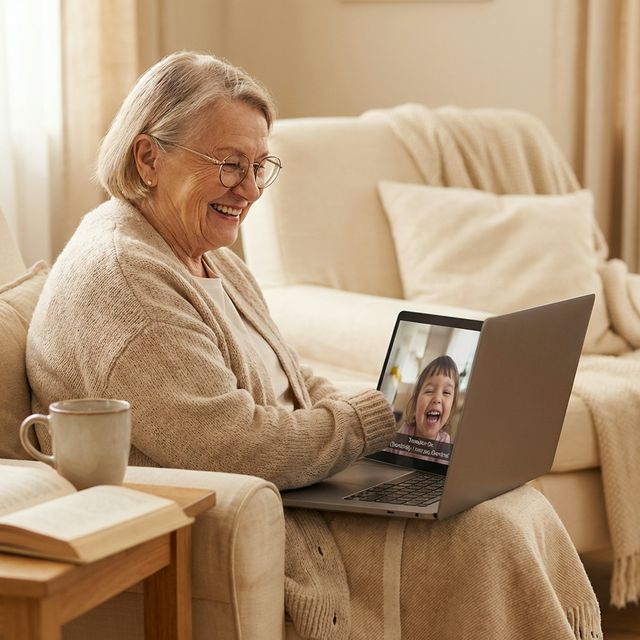
For multilingual families, social isolation is compounded by language barriers. A grandparent who cannot communicate with their grandchildren experiences a double isolation — geographic and linguistic.
Video Calls and Mental Health: What Studies Show
Research published in PubMed (National Institutes of Health) examined how digital communication affects older adults with sensory impairments during periods of social isolation. The study, using data from the National Social Life, Health, and Aging Project, found that video calls mitigated depressive feelings in a dose-dependent manner — meaning more frequent calls produced greater protective effects.
A Cochrane rapid review examining video calls for reducing social isolation and loneliness in older people found that while short-term effects on depression were modest, longer-term video call programs (12+ months) showed measurable improvements in reducing loneliness scores.
The key insight from both studies: consistency matters more than duration. A short weekly video call does more for well-being than an occasional long one.
Why Video Calls Work Better Than Phone Calls
The research points to a critical advantage of video over audio-only communication:
- Facial expressions provide emotional context that words alone cannot convey
- Visual cues help compensate for language comprehension gaps
- Shared visual activities (showing photos, cooking together on screen) create connection beyond words
- Non-verbal communication bridges up to 65% of conversational meaning
For multilingual families where language comprehension may be limited, the visual channel of video calls is not optional — it is essential.

Heritage Language Loss: The Hidden Cost of Immigration
UNESCO's Warning
According to UNESCO, approximately 40% of the world's 7,000 languages are classified as endangered. A language disappears roughly every two weeks. While this crisis plays out at the global level, the same pattern occurs within individual families:
- Children lose fluency in their grandparents' language
- Cultural identity weakens as linguistic connection fades
- Family bonds suffer when direct communication becomes impossible
Research in cross-cultural psychology consistently shows that heritage language loss correlates with weaker emotional bonds between generations, reduced sense of cultural identity, and increased family tension.
Technology as a Bridge, Not a Replacement
No technology can replace the richness of speaking the same language fluently. But for families where language loss has already occurred, real-time translation tools offer something that was previously impossible: meaningful, direct conversation across the language barrier.
This is fundamentally different from having one family member translate for everyone else. That relay approach is:
- Exhausting for the translator
- Incomplete (nuances and emotions are lost in relay)
- Exclusionary (the non-speaking person feels like an outsider in their own family)
Video Call Translation Tools Compared
Google Meet: AI Translation (2025)
In 2025, Google announced real-time speech translation in Google Meet, powered by Gemini AI. The feature translates spoken words while preserving the speaker's voice characteristics.
Strengths:
- Voice preservation creates a natural feeling
- Integrated directly into Google Meet
Limitations:
- Initially supports only English and Spanish (expanding to Italian, German, Portuguese)
- Requires Google AI Pro or Ultra subscription
- Only works within Google Meet — not on Zoom, FaceTime, WhatsApp, or Viber
- Designed for business meetings, not optimized for casual family conversations
Zoom and Skype
- Zoom offers AI-translated captions in up to 36 languages, but requires paid plans and captions are text-only
- Skype has offered translation since 2014, but quality has not kept pace with modern AI
The Platform Lock-In Problem: Why Most Video Call Translation Tools Fall Short
All platform-specific solutions share one fundamental limitation: they only work on their own platform. Families do not choose video call platforms based on translation features — they use whatever their relatives already have installed:
| Family member | Likely platform |
|---|---|
| Grandma in Vietnam | Zalo or WhatsApp |
| Uncle in Mexico | WhatsApp or FaceTime |
| Cousin in Korea | KakaoTalk or Zoom |
| Parents in China |
A translation solution that only works on one platform solves the problem for almost no one.
How FluentCap Provides Real-Time Translation for Family Calls
FluentCap takes a fundamentally different approach to family video call translation: instead of integrating with a single platform, it captures audio directly from your computer's sound system. This means it works with every video call platform — you can translate WhatsApp family calls, FaceTime conversations, and Zoom gatherings without switching apps.
Platform Compatibility
| Platform | Works with FluentCap |
|---|---|
| Zoom | ✅ |
| Google Meet | ✅ |
| WhatsApp Web | ✅ |
| FaceTime (Mac) | ✅ |
| Viber Desktop | ✅ |
| WeChat Desktop | ✅ |
| Facebook Messenger | ✅ |
| Any browser-based call | ✅ |
How a Translated Family Call Works
- Start your video call on whatever platform your family uses
- Open FluentCap — it captures audio from your computer automatically
- See real-time transcription in the original language (what your relative is saying)
- Read the translation in your language instantly
The other person does not need to install anything. They just speak naturally on whatever platform they already use.
Why This Matters for Families
- No technical setup burden on elderly family members
- Works with any audio quality — even if grandma's internet is not great
- Multiple provider options for different languages — choose the best accuracy for your family's language
- See all features or check how it works
See It in Action
Here is FluentCap generating real-time Vietnamese-to-English captions during a video call:
Practical Guide: Setting Up Your First Translated Family Call
Step 1: Choose the Right Provider
FluentCap connects to multiple speech-to-text providers. For family calls, choose based on your relative's language:
| Language | Recommended provider | Why |
|---|---|---|
| Spanish, Portuguese | Deepgram | High accuracy for Latin American and European dialects |
| Mandarin, Cantonese | Gladia | Strong multi-Chinese variant support |
| Korean, Japanese | Deepgram or AssemblyAI | Both perform well for East Asian languages |
| Vietnamese, Thai | Gladia | Best coverage for Southeast Asian languages |
| Arabic, Hindi | Deepgram | Good dialectal coverage |
Step 2: Optimize Audio Quality
Clear audio is the biggest factor for transcription accuracy:
- Ask your relative to use headphones or earbuds — reduces echo and background noise
- Close unnecessary browser tabs — frees bandwidth for better audio
- Choose a quiet room — background TV or music reduces accuracy significantly
- Speak at a natural pace — not slower, just clearer
Step 3: Start Small
Your first translated family call should be:
- Short (15-20 minutes) — long enough to feel meaningful, short enough to stay comfortable
- One-on-one — group calls are harder for transcription
- At a regular time — building a ritual matters more than call length
Step 4: Build Shared Activities
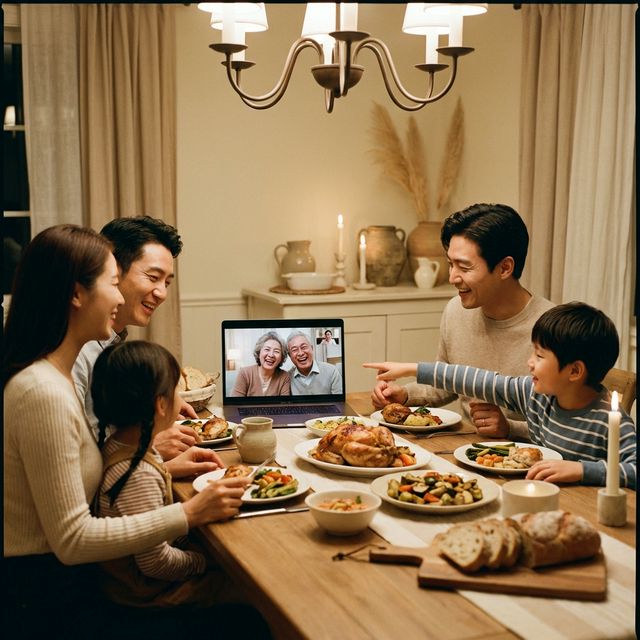
Research on effective video communication shows that shared visual activities create the strongest connections:
- Cook the same recipe simultaneously on camera
- Show photos or videos of daily life
- Play simple games together (card games, drawing games)
- Watch a show together — use FluentCap's subtitles for foreign films during a shared movie night
Tips From Research on Effective Video Communication
Consistency Over Duration
Studies consistently show that frequency matters more than length. A 15-minute weekly call does more for relationship maintenance than a monthly hour-long session. Set a recurring schedule and protect it.
Use the Visual Channel
For multilingual families, the visual component of video calls does heavy lifting:
- Hold up objects when vocabulary fails — showing is often faster than translating
- Use gestures and expressions — they communicate emotion across any language
- Share your screen to show photos, maps, or stories
Include Children Early
Children who see their grandparents regularly on video — even across a language barrier — develop stronger family identity. FluentCap's translation overlay means children can follow along in their language, gradually picking up words and phrases in the heritage language through natural exposure. This mirrors the comprehensible input approach studied extensively in language acquisition research.
Be Patient With Technology
Elderly family members may need help the first few times. Consider:
- Having a bilingual family member present for the initial setup
- Using the simplest possible platform (WhatsApp or FaceTime are usually the easiest)
- Remembering that your relative does not need to install FluentCap — only you do
Thank You to Our Providers
FluentCap is made possible by speech-to-text providers who believe in connecting people:
- Deepgram: $200 in free credits (~750 hours of transcription)
- AssemblyAI: $50 in free credits (~140 hours)
- Gladia: 10 free hours every month
- Shunya: $100 in free credits (~300 hours)
These providers make real-time translation accessible to families worldwide. When your free credits run out, please support them. Their pricing is incredibly fair — just $0.15–0.40 per hour, far cheaper than any subscription translation app. A weekly family call costs less than a cup of coffee per month.
Frequently Asked Questions
Does the other person need to install FluentCap?
No. FluentCap works entirely on your side. It captures the audio playing on your computer during the video call, transcribes it, and shows you the translation. Your family member just speaks naturally on whatever platform they already use — Zoom, WhatsApp, FaceTime, or any other app.
Which languages does FluentCap support for family calls?
FluentCap supports any language handled by its speech-to-text providers. Deepgram covers 36+ languages, Gladia supports 99+ languages, and AssemblyAI offers high accuracy for major languages. Family languages like Spanish, Mandarin, Korean, Vietnamese, Arabic, Hindi, Portuguese, Tagalog, and Japanese are all well supported.
Is real-time translation accurate enough for casual conversation?
Modern speech-to-text technology achieves 85–95% accuracy for most major languages in clear audio conditions. Casual family conversation with reasonable audio quality typically produces good results. For best accuracy, encourage family members to reduce background noise and speak clearly — not slowly, just clearly.
Can I use FluentCap on a tablet or phone?
FluentCap is currently a desktop application for Windows and macOS. For family video calls, we recommend using the desktop version of your preferred platform (WhatsApp Web, Zoom Desktop, Google Meet in a browser) so FluentCap can capture and translate the audio in real-time. This also gives you a larger screen for reading translations comfortably.
Is my family's conversation private and secure?
Yes. FluentCap uses a BYOK (Bring Your Own Key) model — your audio is processed directly by the speech-to-text provider you choose (Deepgram, AssemblyAI, Gladia, or Shunya). FluentCap itself does not store, record, or have access to your conversations. Your family's privacy is protected by design.
How much does it cost for regular family calls?
FluentCap itself is free. You only pay for speech-to-text usage through your chosen provider, and all providers offer generous free tiers. A typical 30-minute weekly family call uses about 2 hours of credit per month — well within the free tier of most providers. When credits expire, the cost is roughly $0.30–0.60 per month at standard pay-as-you-go rates.
Can I translate WhatsApp family video calls in real time?
Yes. FluentCap captures audio directly from your computer's sound system, so it works with WhatsApp Web, WhatsApp Desktop, and any other platform your family uses. Open WhatsApp on your computer, start the video call, then open FluentCap — it will transcribe and translate everything your family member says in real time. Your relative does not need to install anything on their end.
Is real-time translation safe for private family conversations?
Absolutely. FluentCap uses a BYOK (Bring Your Own Key) model, which means your audio goes directly from your computer to the speech-to-text provider you choose — Deepgram, AssemblyAI, Gladia, or Shunya. FluentCap never stores, records, or accesses your conversations. There is no intermediary server. Your family's private moments stay private.
Your Family Is Worth the Effort
The WHO Commission on Social Connection calls loneliness "a pressing health threat." For multilingual families, this threat is intensified by language barriers that turn distance into disconnection.
Technology cannot replace the warmth of speaking the same language. But it can build a bridge that makes real conversation possible — the kind where grandchildren hear their grandmother's stories, where parents express themselves freely, and where families stay families despite the miles between them.
Your family deserves to stay connected. Give FluentCap a try.
Related Articles
Explore more ways FluentCap connects people across languages:
- Learn a Language by Watching Films — The science behind learning from visual media
- Comprehensible Input: Learn English Naturally — How natural exposure drives language acquisition
- Foreign Films with Real-Time Subtitles — Watch world cinema without language barriers
- Real-Time Captions for Deaf and Hard of Hearing — Accessibility for everyone
- FluentCap for International Meetings — Professional communication across languages
— FluentCap Team
Built to bring good things to the world.