How to Learn Japanese by Watching Anime
Turn your anime obsession into Japanese fluency. Learn practical methods to absorb vocabulary, improve listening comprehension, and understand Japanese culture through your favorite shows.
Table of Contents
- Why Anime Is Perfect for Learning Japanese
- The Science Behind Anime Language Learning
- The Subtitle Problem Every Anime Fan Faces
- How FluentCap Helps You Learn Japanese Watching Anime
- Your Step-by-Step Method to Learn Japanese Watching Anime
- Best Anime for Each Learning Level
- Common Mistakes to Avoid
- Thank You to Our Providers
- Frequently Asked Questions
From Fan to Fluent: Your Anime Learning Journey Begins
You've watched hundreds of anime episodes. You can recognize "sugoi," "kawaii," and "nani" instantly. You've even caught yourself saying "itadakimasu" before meals. But here's the frustrating part — you still can't understand full conversations without subtitles.
What if your anime obsession could become your most powerful Japanese learning tool?
For millions of anime fans worldwide, this isn't just a dream. Research shows that consistent anime watching, combined with the right techniques, can significantly boost your Japanese comprehension. A peer-reviewed study in Language Learning & Technology found that 38% of native English-speaking anime viewers with no formal Japanese training could correctly answer at least half of the questions on a Japanese listening test.
That's remarkable — and it's just the beginning of what's possible when you learn Japanese watching anime intentionally.
Before we dive into the method, watch this excellent overview of how anime immersion works for Japanese learning:
Why Anime Is Perfect for Learning Japanese
Multi-Modal Learning That Sticks
Unlike textbooks that give you isolated words, anime delivers language through multiple channels simultaneously:
- Audio: Natural Japanese speech with varied tones, speeds, and emotions
- Visual: Facial expressions, gestures, and context clues
- Written: When you add transcription, you see the exact words being spoken
- Emotional: Characters you care about saying words you want to understand
This multi-modal input — the core of the anime study method — is exactly how children learn their native language. Your brain makes connections between sounds, meanings, and contexts automatically, creating a natural Japanese immersion experience from your desktop.
Motivation You Can't Buy
According to research from Cal State University, 81.5% of informal anime viewers self-reported beginner-level listening skills — but they keep watching because they love it. That intrinsic motivation is priceless.
When you're genuinely invested in whether Naruto becomes Hokage or if Light Yagami gets caught, your brain works overtime to understand. No textbook can create that level of engagement.
Cultural Immersion Without a Plane Ticket
Washington State University research confirms that anime provides rich cultural insights — from Japanese humor and social hierarchies to emotional expressions and daily life customs. This cultural context is essential for true language understanding.
When a character bows, you learn about respect. When they speak differently to superiors, you absorb keigo (polite speech) naturally. When they celebrate festivals, you understand traditions.
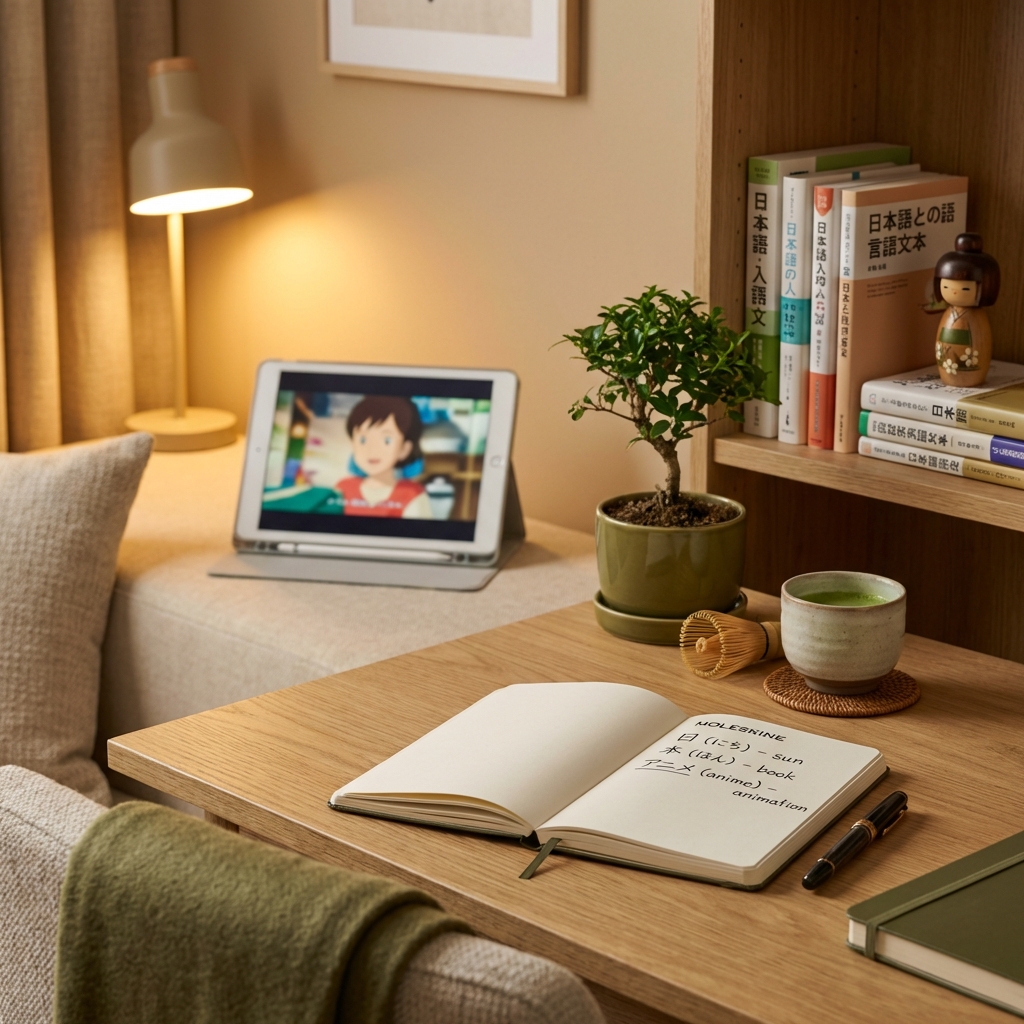
The Science Behind Anime Language Learning
Vocabulary Acquisition Through Context
Traditional flashcard apps teach you that "ame" means "rain." But anime shows you ame — characters running for shelter, umbrellas opening, mood shifting.
Academic research on anime language learning demonstrates that vocabulary learned through visual and auditory context is retained far better than isolated word lists. This anime study method works especially well for JLPT preparation because you're hearing natural speech patterns. In anime:
- Sound + Visual = Memory: Hearing a word while seeing the action creates dual encoding
- Emotional context = Stronger retention: Words learned during exciting scenes stick better
- Repetition across episodes: Common phrases appear naturally, reinforcing learning
- Genre vocabulary: Each genre teaches different word sets — slice-of-life vs. shonen vs. romance
Listening Comprehension Improvement
Anime characters don't speak like language course recordings. They mumble, interrupt, use slang, and speak at natural speeds. This exposure trains your ear for real Japanese.
One key study found that learners who combined anime watching with formal study created a "virtuous cycle" — applying classroom knowledge to anime and vice versa, reinforcing both. This is the foundation of why you can effectively learn Japanese watching anime with the right approach.
The Subtitle Problem Every Anime Fan Faces
Here's what every serious anime fan eventually realizes:
English Subtitles Are Training Wheels You Can't Remove
When English subs are on, your brain reads instead of listening. You're learning the story, not the language. Hours of watching with English subtitles yields almost no Japanese improvement.
Japanese Subtitles Are Often Unavailable
The ideal learning tool — Japanese text matching the spoken audio — is surprisingly rare. Most streaming services don't offer Japanese closed captions, especially for simulcast content.
Fan Subs Take Forever (Or Never Come)
That niche anime you love? The one with the perfect slice-of-life vocabulary for beginners? Good luck finding accurate subtitles within the next year.
Translation ≠ Transcription
Even official subs are translated, not transcribed. They convey meaning, but often change sentence structure, omit words, or localize expressions. You're not seeing what's actually being said.
This is where real-time transcription changes everything. With tools like FluentCap, you can transform any anime into a complete Japanese immersion learning experience.
How FluentCap Helps You Learn Japanese Watching Anime
Real-Time Japanese Transcription
FluentCap captures the audio from any anime playing on your computer and transcribes it in real-time. This means:
- Instant Japanese text — See exactly what characters are saying
- Works with any source — Crunchyroll, Netflix, local files, anything
- No waiting for subs — Even brand new episodes work immediately
- Adjustable settings — Focus on transcription only, or add translation
Side-by-Side Translation When You Need It
For beginners, seeing Japanese text alongside English translation accelerates comprehension. As you improve, you can hide the translation and test yourself.
Pause, Replay, Study
Unlike live TV, you control the pace. Heard an interesting phrase? Pause and study it. Missed something? Replay it. This active engagement is far more effective than passive watching.
Works With Your Workflow
Keep a vocabulary journal on the side. Screenshot interesting phrases. Copy text for Anki flashcards. FluentCap fits into whatever study system works for you.
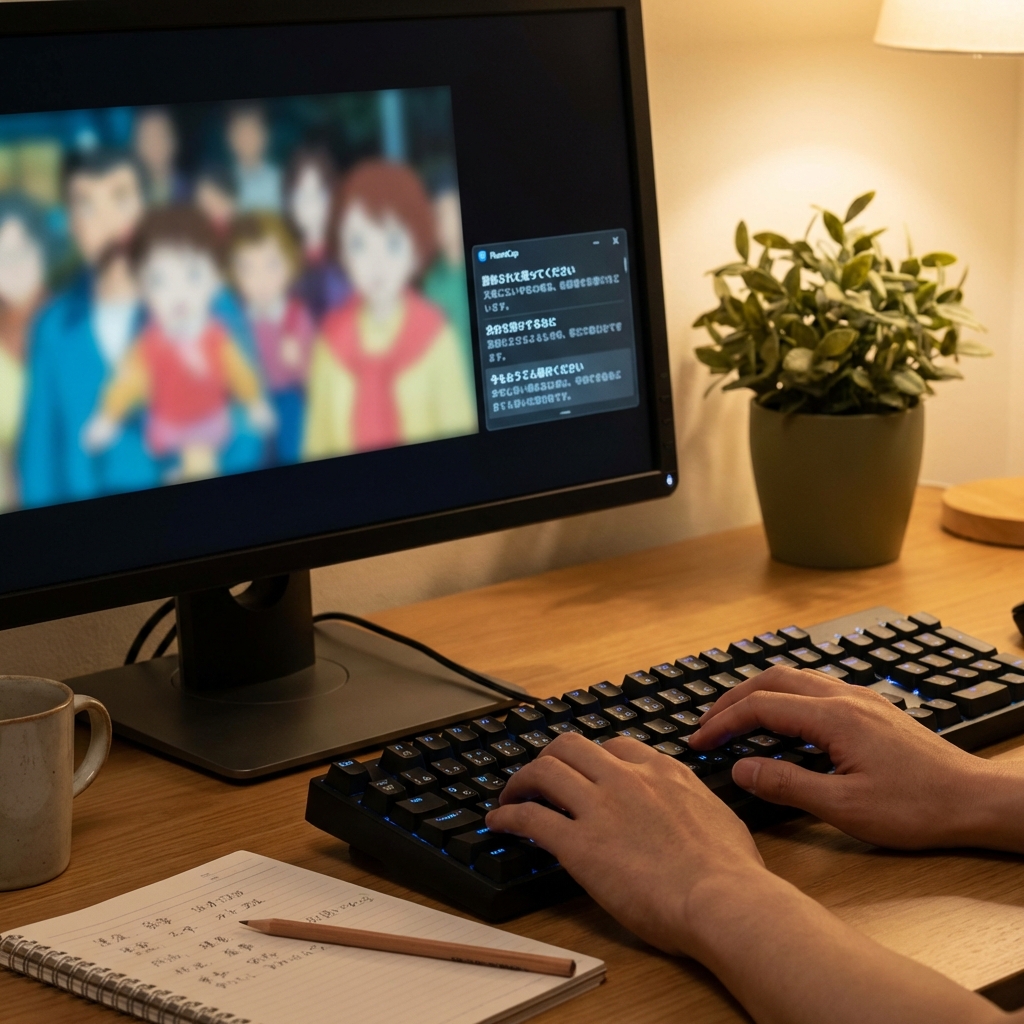
Your Step-by-Step Method to Learn Japanese Watching Anime
Step 1: Choose Anime at Your Level
Not all anime is created equal for language learning:
| Level | Recommended Genres | Why |
|---|---|---|
| Beginner | Slice-of-life, Children's | Simple vocabulary, clear speech, everyday situations |
| Intermediate | Romance, Comedy | Natural conversations, emotional expression, common phrases |
| Advanced | Shonen, Mystery, Sci-fi | Complex vocabulary, fast speech, technical terms |
Step 2: Set Up Your Learning Environment
- Open your anime on any streaming service or local player
- Launch FluentCap to capture system audio (learn more about free transcription hours)
- Position the transcription window where you can see it comfortably
- Have a note-taking app or vocabulary journal ready
Step 3: Active Watching Protocol
Don't just passively watch. Use this method:
- First pass: Watch a scene with translation to understand the story
- Second pass: Watch again focusing on Japanese text
- Identify new words: Pause when you see unfamiliar vocabulary
- Note patterns: Notice how characters speak differently (casual vs. polite)
- Repeat key phrases: Practice pronunciation by mimicking characters
Step 4: Build Your Vocabulary System
Every session, capture 5-10 new words or phrases. Options include:
- Physical notebook: Write kanji, hiragana, and meaning
- Anki flashcards: Create cards with audio clips from the anime
- Spreadsheet: Track progress over time
- Language apps: Add words to your Bunpo or WaniKani studies
Step 5: Combine With Formal Study
Anime is a powerful supplement, but not a complete curriculum. Pair it with:
- Grammar study: Understand the patterns you're hearing
- Kanji practice: Recognize more words in transcriptions
- Speaking practice: Use what you've learned in conversation
- Writing practice: Cement vocabulary through active use
Best Anime for Each Learning Level
Beginner (N5-N4 Level)
| Anime | Why It Works |
|---|---|
| Shirokuma Cafe | Simple vocabulary, slow speech, cute animals |
| Chi's Sweet Home | Children's anime, basic daily expressions |
| Yotsuba&! (manga) | Everyday situations, child's perspective |
| K-On! | School life vocabulary, clear pronunciation |
| My Neighbor Totoro | Classic Ghibli, simple dialogue, heartwarming |
Intermediate (N4-N3 Level)
| Anime | Why It Works |
|---|---|
| Your Name (Kimi no Na wa) | Natural teen dialogue, emotional vocabulary |
| Spirited Away | Rich vocabulary, cultural references |
| Terrace House | Reality show = real conversations |
| Mob Psycho 100 | Varied speech patterns, humor |
| Aggretsuko | Office vocabulary, modern slang |
Advanced (N3-N1 Level)
| Anime | Why It Works |
|---|---|
| Attack on Titan | Military vocabulary, complex politics |
| Death Note | Intellectual dialogue, formal speech |
| Monster | Adults talking to adults, nuanced Japanese |
| Steins;Gate | Science terms, fast-paced dialogue |
| Vinland Saga | Historical vocabulary, varied registers |
Common Mistakes to Avoid
Mistake 1: Anime-Only Study
Anime is incredible for listening and vocabulary in context. But it won't teach you:
- How to read kanji systematically
- Grammar rules and exceptions
- How to construct your own sentences
- Formal writing skills
Solution: Use anime as ONE pillar of a comprehensive study plan.
Mistake 2: Copying Anime Speech in Real Life
Anime characters often use:
- Exaggerated informal speech: "Ore wa..." (very masculine, casual)
- Dramatic expressions: Perfect for fiction, weird in real conversations
- Character-specific speech patterns: Unique to that character
- Slang and made-up words: Not standard Japanese
Solution: Be aware of register differences. Learn to recognize casual vs. polite speech, and know when each is appropriate.
Mistake 3: Passive Watching
Watching 100 episodes while browsing your phone = minimal learning. Your brain needs to be engaged.
Solution: Use the active watching protocol. Pause, take notes, repeat phrases. Make it a study session, not just entertainment.
Mistake 4: Starting Too Hard
Jumping straight into Death Note as a complete beginner = frustration and confusion.
Solution: Start with children's anime or slice-of-life. Build vocabulary before tackling complex shows.

Thank You to Our Providers
FluentCap's real-time transcription is made possible by amazing speech-to-text providers who believe in making technology accessible:
- Deepgram: Offers $200 in free credits (~750 hours of transcription)
- AssemblyAI: Provides $50 in free credits (~140 hours)
- Gladia: Gives 10 free hours every month
- Shunya: Offers $100 in free credits (~300 hours)
These providers power the real-time Japanese transcription that makes anime learning possible. When your free credits run out, we encourage you to support them. Their pricing is incredibly fair — just $0.15-0.40 per hour, which is 60-80% cheaper than traditional subscription apps.
They deserve your support for making speech-to-text technology accessible to anime fans and language learners around the world.
Frequently Asked Questions
Can I really learn Japanese just by watching anime?
Anime is a powerful learning tool, but it works best as a supplement to structured study. Research shows it significantly improves listening comprehension and vocabulary retention when combined with grammar study and speaking practice. You'll absorb natural speech patterns and cultural context that textbooks can't provide.
How long will it take to understand anime without subtitles?
According to the U.S. Foreign Service Institute (FSI), Japanese is a Category IV language requiring approximately 2,200 hours for proficiency. With consistent daily anime study (1-2 hours), you might understand basic conversations within 6-12 months, with full comprehension taking 3-5 years of dedicated practice.
What about the informal speech in anime?
This is a valid concern. Anime often uses casual, exaggerated, or character-specific speech. The key is awareness — learn to recognize different speech registers (casual, polite, formal) and understand that anime dialogue isn't always appropriate for real-world situations. Use anime to train your ear, but study proper usage separately.
Do I need Japanese subtitles or is transcription better?
Real-time transcription with FluentCap shows you exactly what's being said, unlike translated subtitles that often change sentence structure. This is ideal for learning because you're matching sounds to the actual Japanese words. As you advance, you can turn off the translation and test your pure comprehension.
Which anime genre is best for learning?
For beginners, slice-of-life and children's anime offer simple, everyday vocabulary with clear speech. For intermediate learners, romance and comedy provide natural conversational Japanese. Advanced learners benefit from shonen and mystery genres with complex vocabulary and faster speech.
Is watching anime better than taking a Japanese class?
They serve different purposes. Classes teach structure, grammar, and proper usage. Anime provides immersive listening practice and cultural context. The ideal approach combines both — use classroom knowledge to understand anime better, and use anime to reinforce what you learn in class.
Start Your Anime Learning Journey Today
You already love anime. You already spend hours watching your favorite shows. Now it's time to transform that passion into real Japanese skills.
With real-time transcription, every anime episode becomes a language lesson. No waiting for subtitles. No missing what characters actually say. Just you, great anime, and a world of Japanese to learn.
We built FluentCap to bring good things to the world. And we believe that understanding Japanese — through the anime you already love — is one of the best gifts you can give yourself.
The next episode is waiting. Start learning Japanese with it today.
Related Articles
More ways to use FluentCap for language learning:
- Learn Languages by Watching Movies — Apply these techniques to any foreign language content
- Watch Foreign Movies with Real-Time Subtitles — Enjoy films from any country with instant translations
- Free Transcription: 750+ Hours Available — Maximize your free credits from providers
— FluentCap Team
Every conversation. Every language. Understood.