Language Barriers in Education: How Tech Bridges the Gap
A 2025 UNESCO report reveals that 40% of the global population lacks access to education in a language they understand. Here is how technology is changing that reality for millions of students.
- The Global Language Crisis in Education
- How Language Barriers Affect Students Daily
- Technology as the Great Equalizer
- How Can Schools Overcome Language Barriers in Education?
- Real-World Impact: Breaking Down Walls
- Thank You to Our Providers
- Frequently Asked Questions
A Problem Hiding in Plain Sight
Language barriers in education affect millions of students worldwide — and the problem is far bigger than most people realize. A groundbreaking 2025 UNESCO Global Education Monitoring report, "Languages Matter," revealed a startling truth: 40% of the global population does not have access to education in a language they speak or understand fluently.
That is not a small demographic. It is nearly 3 billion people — students sitting in classrooms, watching online lectures, attending webinars — trying to learn while simultaneously fighting to decode an unfamiliar language.
At FluentCap, we read this report and recognized a challenge we have been working to address since day one. Language should never be a barrier to understanding, learning, or connecting with others. That belief is why FluentCap exists.
The Global Language Crisis in Education
The Numbers Are Staggering
The UNESCO "Languages Matter" report paints a concerning picture of global education:
| Finding | Impact |
|---|---|
| 40% of learners | Cannot access education in their native language |
| 90% in some regions | Low and middle-income countries face the worst gaps |
| 31+ million displaced youth | Face language barriers in their host country's education system |
| Reading gap widened | From 12 to 18 percentage points between native and non-native learners (2010–2022) |
| Math gap widened | From 10 to 15 percentage points in the same period |
These are not abstract statistics. They represent real students who fall behind — not because they lack intelligence or motivation, but because they cannot fully understand what is being taught.
The International Student Experience
The challenges extend beyond developing nations. According to OECD Education at a Glance 2024, international student mobility reached record levels — yet language remains the single most cited barrier to academic success. In 2025, international student enrollment in the United States dropped by 17%, partly driven by tightened visa policies and a growing sense of uncertainty. Countries like Australia, Canada, and the UK are also implementing stricter requirements, including higher language proficiency thresholds.
For those who do study abroad, the classroom experience can be overwhelming. Even students with strong test scores often struggle with:
- Fast-paced lectures delivered in accented or colloquial speech
- Academic jargon not covered in language textbooks
- Group discussions where multiple speakers talk at natural speed
- Online courses without reliable subtitles or transcription
How Language Barriers Affect Students Daily
The Hidden Cost of Not Understanding
When a student cannot fully understand a lecture, the consequences ripple outward:
Academic Performance: Research from the UNESCO report shows that between 2010 and 2022, the learning gap between students educated in their home language versus a foreign language has consistently widened. The World Bank's education research confirms that students who do not receive instruction in their home language experience significant learning losses in reading and mathematics.
Mental Health: The constant effort of decoding language while simultaneously trying to learn new concepts leads to cognitive overload. Students report higher anxiety, lower confidence, and feelings of isolation.
Missed Opportunities: Many talented students avoid asking questions, participating in discussions, or pursuing advanced courses simply because they fear language-related embarrassment.
The Online Learning Paradox
The rise of online education should have been a great equalizer. Platforms like Coursera, edX, and YouTube offer world-class lectures from top universities — often for free.
But here is the paradox: the best educational content is overwhelmingly in English.
A student in Vietnam wanting to learn machine learning from Stanford, or a student in Brazil studying philosophy from Oxford, faces the same barrier: the lecture is in a language they do not fully understand.
Traditional subtitles help, but they are:
- Often unavailable for live lectures and webinars
- Delayed or inaccurate on auto-generated platforms
- Not available in the student's native language
- Impossible to customize for different proficiency levels
Technology as the Great Equalizer
Bridging the Gap with Real-Time Transcription
This is where FluentCap saw an opportunity to help.
We built FluentCap because we believe every student deserves to understand what is being taught — regardless of what language the lecture is delivered in.
How FluentCap helps students:
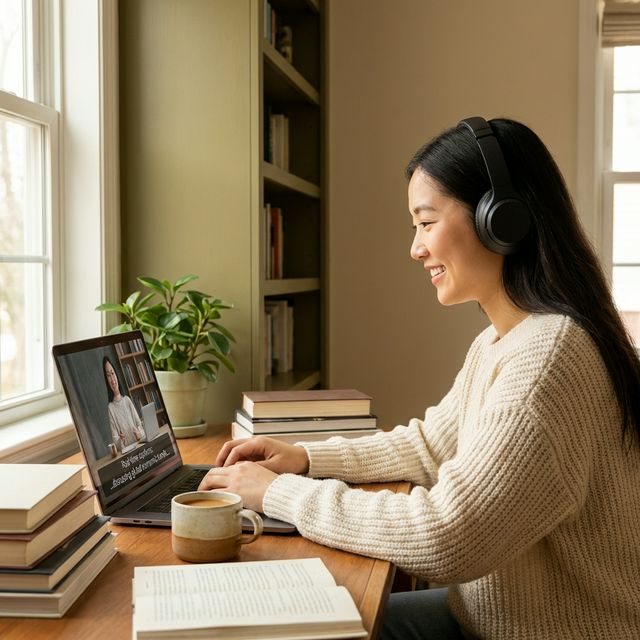
- Play any educational content on your computer — lecture recordings, webinars, online courses, educational podcasts
- See real-time transcription of exactly what is being said
- Add optional translation to your native language for additional support
- Adjust support levels as your language skills improve
This transforms any lecture, in any language, into comprehensible input — content you can actually understand and learn from.
Adapting to Every Student's Level
One of the most powerful aspects of real-time transcription is its flexibility:
| Student Level | How FluentCap Helps |
|---|---|
| Beginner | Full transcription + translation — understand everything |
| Intermediate | Transcription only — practice listening while reading along |
| Advanced | Occasional check — verify understanding of complex terms |
| Near-Native | Quick reference — catch unfamiliar academic jargon |
This graduated approach aligns perfectly with comprehensible input theory — the research-backed principle that language acquisition happens best when you understand 90–98% of what you hear.
Beyond the Classroom
FluentCap is not limited to formal education. Students can use it for:
- Research presentations from international conferences
- Guest lectures by visiting professors from other countries
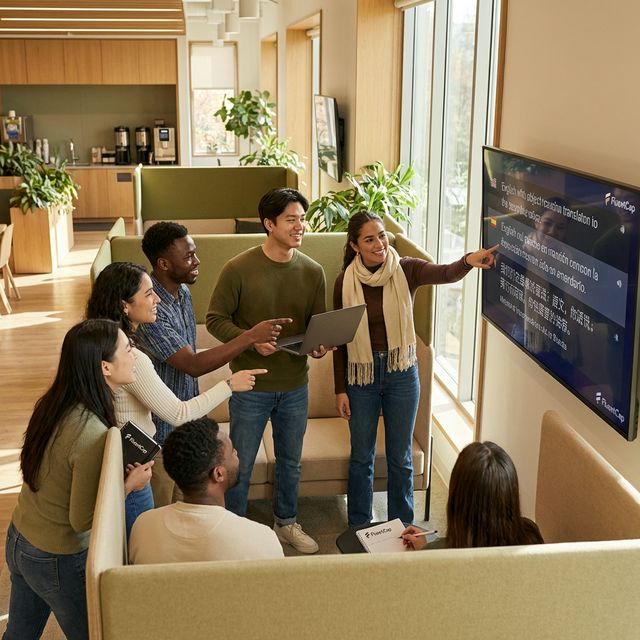
- Study group sessions with classmates who speak different languages
- Educational YouTube channels in any language
- Podcast lectures from global thought leaders
How Can Schools Overcome Language Barriers in Education?
Overcoming language barriers in education requires a combination of institutional policy and accessible technology. Here are proven strategies that schools, universities, and individual learners can adopt:
-
Embrace multilingual education policies: UNESCO recommends using at least three languages in classrooms — the mother tongue, a national language, and an international language. This layered approach respects linguistic diversity while building global readiness.
-
Invest in teacher training: Educators need professional development to support multilingual learners effectively. Understanding code-switching, scaffolding techniques, and culturally responsive teaching makes a measurable difference.
-
Leverage real-time transcription technology: Tools like FluentCap allow students to access real-time captions and translations for any audio content on their computer — bridging the gap instantly without waiting for institutional solutions.
-
Provide accessible learning materials: Offering lecture recordings, transcripts, and multilingual resources gives students the flexibility to review content at their own pace.
-
Create inclusive classroom cultures: When educators acknowledge language diversity as an asset rather than a deficit, students feel safer participating, asking questions, and taking academic risks.
The most effective approach combines top-down institutional change with bottom-up technology solutions that empower individual students right now.
Real-World Impact: Breaking Down Walls
The Economics of Accessibility
Professional captioning services for educational content can cost $150 or more per hour. For universities, this expense limits which courses and events receive captioning support.
FluentCap's approach — powered by incredible speech-to-text providers — brings this cost down to just $0.15–0.40 per hour through a bring-your-own-key model. That is a reduction of over 99%, making real-time transcription accessible to individual students, not just well-funded institutions.
Self-Paced Learning
Unlike a live classroom where you either keep up or fall behind, FluentCap combined with recorded content lets students:
- Pause and review difficult passages
- Re-read transcriptions at their own pace
- Build vocabulary by noting unfamiliar terms in context
- Revisit complex concepts without the pressure of real-time comprehension
A Tool for Educators Too
Teachers and professors working with multilingual classrooms can recommend FluentCap to students as a supplementary tool. It does not replace good teaching — it removes one barrier so that good teaching can reach every student.
Thank You to Our Providers
FluentCap is made possible by amazing speech-to-text providers who believe technology should be accessible to everyone:
- Deepgram: Offers $200 in free credits (~750 hours of transcription)
- AssemblyAI: Provides $50 in free credits (~140 hours)
- Gladia: Gives 10 free hours every month
- Shunya: Offers $100 in free credits (~300 hours)
We are deeply grateful to these providers for making high-quality transcription affordable and accessible. When your free credits run out, we encourage you to support them. Their pricing is incredibly fair — just $0.15–0.40 per hour, which is 60–80% cheaper than traditional subscription apps. They deserve your support for making this technology available to students worldwide.
Frequently Asked Questions
How do language barriers in education affect student performance?
According to the 2025 UNESCO Global Education Monitoring report, the learning gap between students educated in their home language and those in a foreign language has widened significantly. Between 2010 and 2022, reading proficiency gaps increased from 12 to 18 percentage points, and math gaps grew from 10 to 15 percentage points. Students facing language barriers often experience lower grades, higher anxiety, and reduced participation in class.
Can technology really solve the language barrier problem in education?
Technology alone cannot solve systemic educational inequities, but it can significantly reduce one major barrier. Real-time transcription and translation tools like FluentCap transform any audio content into comprehensible text, allowing students to understand lectures, webinars, and courses regardless of the delivery language. This supplements — rather than replaces — broader multilingual education efforts.
How does FluentCap help international students specifically?
FluentCap works with any audio on your computer, including lecture recordings, online courses, webinars, and educational podcasts. International students can see real-time transcription of what their professors say, optionally translated into their native language. As their language skills improve, they can gradually reduce the support level — practicing listening while having a safety net available.
Is FluentCap free for students?
FluentCap itself is free forever. Students only pay speech-to-text providers directly for transcription services. These providers offer generous free tiers — hundreds of hours of free transcription to get started. Deepgram alone offers $200 in free credits, enough for approximately 750 hours of lectures.
What languages does FluentCap support for transcription?
FluentCap supports transcription in dozens of languages through its providers, including English, Spanish, French, German, Japanese, Korean, Chinese, Arabic, Portuguese, Hindi, and many more. Translation to your native language is also available, making content in virtually any language accessible.
Every Student Deserves to Understand
The UNESCO report makes one thing clear: language barriers in education are not a niche problem — they affect billions of people worldwide. And these barriers are growing, not shrinking.
We built FluentCap because we believe that understanding should not depend on which language you were born into. Every lecture, every course, every educational moment deserves to be accessible.
Technology cannot solve every challenge in global education. But it can ensure that when a brilliant student sits down to learn, the language of the lecture is not what holds them back.
Try real-time transcription for education with FluentCap — your next lesson is waiting to be understood.
Related Articles
More ways FluentCap supports learning:
- Comprehensible Input: Learn English Naturally — The science behind understanding content at your level
- Learn Languages by Watching Movies — Turn entertainment into education
- Real-Time Captions for Deaf & Hard of Hearing — Accessibility for everyone
- Free Transcription: 750+ Hours Available — Get started with generous provider credits
— FluentCap Team
Built to bring good things to the world.