Your Brain’s First 100 Days in a New Country — What Neuroscience Reveals About Language Immersion
Your brain starts changing within the first week of living abroad. From gray matter growth to rewired neural pathways, here is what peer-reviewed neuroscience reveals about the invisible transformation happening inside your head during the first 100 days in a new country.
- The Moment Everything Sounds Like Static
- Week 1–2: The Honeymoon — Neuroplasticity and Phonetic Tuning
- Week 3–6: The Culture Shock Crash — When Your Brain Fights Back
- Week 7–10: The Cognitive Shift — From Declarative to Procedural Memory
- Week 11–14: The Bilingual Brain Breakthrough
- Language Immersion Timeline: 100 Days of Brain Changes
- Why Some People Adapt to a New Language Faster
- How to Reduce Cognitive Load During Language Immersion
- You Are Already Changing
- Frequently Asked Questions
The Moment Everything Sounds Like Static
You step off the plane. The airport signs are in a script you cannot read. The customs officer speaks to you and the words blur together into one continuous, incomprehensible sound. You smile, nod, and point at your passport.
On the taxi ride to your apartment, the driver talks on his phone. You catch nothing — not a single word. The radio plays a song that could be beautiful or terrible; you have no way to know. Street signs pass the window like abstract art.
This is Day 1.
And here is what nobody tells you: at this exact moment, while you feel lost and slightly panicked, your brain has already begun to change. Not metaphorically. Physically. Neurons are firing in patterns they have never fired before. Your auditory cortex is scrambling to categorize sounds it has never encountered. Gray matter is beginning to reorganize.
You do not feel it. You just feel overwhelmed. But the transformation has started.
“The human brain does not wait for permission to learn. Immersion forces neuroplastic changes that begin within hours of exposure to a new linguistic environment.” — Adapted from research on adult neuroplasticity in language learning (Wei et al., PNAS 2024)
This article follows that transformation — day by day, week by week — through the lens of what neuroscience actually tells us about the first 100 days of language immersion. Whether you are preparing for life abroad with language barriers or already navigating the challenge of understanding native speakers, the science of what happens inside your head may change how you think about the journey.
This is not a guide on how to study harder. It is the story of what happens inside your head when you have no choice but to adapt.
Week 1–2: The Honeymoon — Neuroplasticity and Phonetic Tuning
The Emotional Landscape
Everything is novel. The taste of unfamiliar food. The rhythm of a language you do not speak. The unspoken rules of a culture you do not understand. Your brain is flooded with dopamine — the neurotransmitter of novelty and reward — because everything is a first experience.
Anthropologist Kalervo Oberg first described this pattern in 1954 as the “honeymoon stage” of culture shock. You are fascinated by differences. You take photos of grocery stores. You find it charming that you cannot read a menu.
But beneath the excitement, your brain is doing something remarkable.
How Language Immersion Triggers Phonetic Tuning
Neuroscience research reveals that language immersion triggers immediate changes in auditory processing. Studies on cortical tracking of second-language speech have shown that within the first two weeks of exposure to a new phonological system, the brain begins phonetic tuning — the process of recalibrating which sound distinctions matter (Zhang et al., 2024).
Your brain arrives with a lifetime of phonetic categories optimized for your native language. English speakers, for example, distinguish between “r” and “l” automatically, while Japanese speakers do not — because Japanese treats them as the same sound. In the first two weeks of immersion, your auditory cortex starts building new categories for sounds that your native language never required you to hear.
You do not notice this happening. What you notice is exhaustion.
Why Language Fatigue Hits Hardest in the First Weeks
“Language fatigue” is real, and it hits hardest in the first two weeks. Your brain is working overtime — processing not just unfamiliar sounds, but unfamiliar social cues, unfamiliar navigation, unfamiliar everything.
Research on cognitive load theory (Sweller, 2011) explains why: your working memory — the brain’s scratchpad for active processing — has a limited capacity. When every interaction requires conscious effort (decoding sounds, guessing meanings, processing facial expressions for clues), your cognitive resources deplete rapidly.
This is why you fall asleep at 8 PM during your first week abroad, even though you did nothing physically demanding. Your brain burned through its energy budget by lunchtime.
A person gazes out a window in a new city, experiencing the contemplative exhaustion of language adaptation during their first days abroad.

Week 3–6: The Culture Shock Crash — When Your Brain Fights Back
The Emotional Landscape
The honeymoon ends. What was charming becomes frustrating. You cannot order food the way you want it. You missed an important appointment because you misunderstood the time. A neighbor tried to tell you something urgent and you could only stare blankly.
Psychologist Sverre Lysgaard’s U-curve model of cultural adjustment describes this phase as the bottom of the emotional curve — the “crisis stage.” Homesickness hits hard. You dream in your native language more vividly than ever. You start avoiding interactions because they require too much effort.
This is where most people give up. They retreat into expat bubbles, English-language media, and familiar routines. Their brains stop receiving input.
But if you stay in the discomfort, something extraordinary happens.
White Matter Plasticity: How Your Brain Rewires Its Language Network
A 2024 study published in PNAS by researchers at the Max Planck Institute for Human Cognitive and Brain Sciences (Wei et al.) tracked 59 Syrian refugees learning German through an intensive immersion program. Using high-resolution MRI and tractography, they observed that during the first months of language learning, the brain strengthened white matter connections within the language network.
White matter is the insulation around neural fibers that determines how fast signals travel between brain regions. More white matter means faster communication. The language-learning brain literally rewires its information highways.
Even more striking: the study found that additional brain regions in the right hemisphere — which in monolinguals plays a secondary role in language — became activated. Your brain is not just learning words. It is recruiting new territory to handle the processing demands of a second language.
Key finding: The Max Planck researchers found that connectivity between language areas within each hemisphere increased with learning progress, while connectivity between hemispheres decreased — suggesting the corpus callosum allows the brain to integrate the new language by reducing inhibition from the dominant left hemisphere.
At this stage, you may feel like you are making zero progress. That feeling is misleading. Your brain is doing heavy infrastructure work — laying down neural highways that will eventually carry fluent language use. You just cannot see the roads yet.
This is also the phase where reducing cognitive load becomes critical. Tools that help you see words while hearing them — like real-time transcription during conversations or media — can bridge the gap between what your ears cannot yet decode and what your eyes can process. Linguists call this phonological-orthographic mapping, and research shows it accelerates vocabulary acquisition significantly.
The “Noise Becomes Music” Phenomenon
Around week 4–5, something subtle happens: you start hearing word boundaries.
In the first weeks, the foreign language sounded like one continuous stream of noise. Your brain could not tell where one word ended and another began. But through sheer exposure, your temporal lobe — specifically the superior temporal gyrus, which processes speech sounds — has been running statistical analyses on the input (Giraud & Poeppel, 2012).
It has noticed which sound combinations occur frequently (likely word boundaries) and which do not. Without any conscious study, your brain has started segmenting the speech stream into candidate words.
You still do not know what the words mean. But you can hear them as separate units. The noise has become music with a beat you can follow — even if you do not know the lyrics.
Week 7–10: The Cognitive Shift — From Declarative to Procedural Memory
The Emotional Landscape
The crisis stabilizes. You have learned enough phrases to survive daily interactions. The grocery store clerk recognizes you. You have a route you walk without checking a map. Oberg calls this the “adjustment stage” — not yet comfort, but the absence of constant panic.
You start having small victories: you understood a joke on television. You overheard a conversation and followed the topic. You caught yourself thinking a word in the new language before the English equivalent.
Adult Neuroplasticity in Action: Gray Matter Growth
Studies on intensive language learning programs have shown that two to three months of consistent immersion produces measurable decreases in brain activation during language tasks. This sounds counterintuitive — less brain activity means more learning?
Yes. Here is why: in the early weeks, your brain activated massive neural networks to process even simple sentences. Every word required effortful decoding. But after 7–10 weeks of immersion, your brain has built enough automated pathways that some processing happens without conscious effort.
This is the shift from declarative memory (conscious knowledge: “this word means X”) to procedural memory (automatic skill: hearing the word and understanding it instantly). It is the same shift that happens when you learn to drive — at first every action is conscious, then it becomes automatic.
Research demonstrates that this shift correlates with increased gray matter density in the left inferior frontal gyrus — the brain region responsible for speech production and grammatical processing. L2 training over three months or more is associated with gray matter volume increases in both inferior and middle frontal regions (Pereira et al., 2023). Your brain is literally growing denser tissue in the areas responsible for language.
How Bilingual Brain Development Creates a Dual Operating System
Around this time, researchers have observed what they call the “parallel activation” phenomenon. When you hear or see a word in your new language, your brain simultaneously activates the corresponding word in your native language — and then suppresses it.
This constant activation-and-suppression is like running two operating systems simultaneously. It is exhausting, but a 2025 review by Marian and Hayakawa on the consequences of bilingual language coactivation demonstrates that this process builds enhanced executive function. Bilingual brains consistently outperform monolingual brains on tasks requiring attention switching, inhibition, and cognitive flexibility.
You are not just learning a language. You are upgrading your brain’s control center.
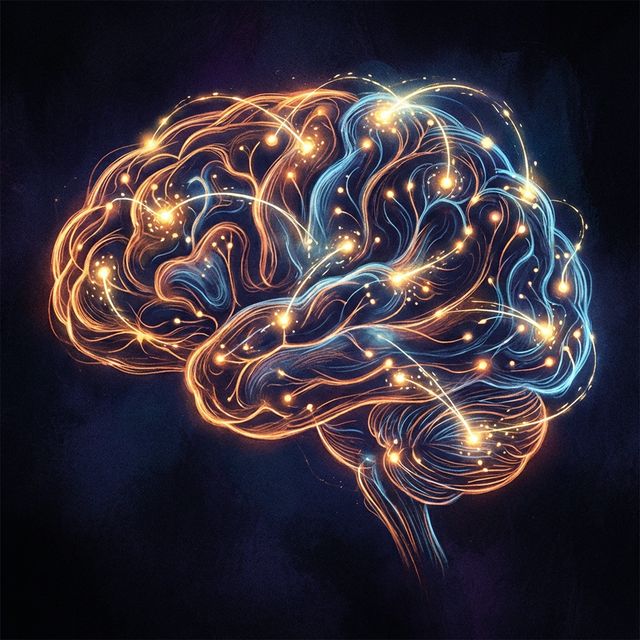
Visualization of neural pathways forming and strengthening during language learning — the invisible architecture of bilingual brain development.
Week 11–14: The Bilingual Brain Breakthrough
The Emotional Landscape
You are ordering food without rehearsing the sentence in your head first. You understood an entire conversation between strangers on the bus and did not realize until afterward that it was in the foreign language. You caught yourself thinking in the new language for the first time.
This is the beginning of what Lysgaard called the “recovery” phase — not because you were sick, but because your sense of self is stabilizing in a new form. You are no longer the person who arrived on Day 1. You are not yet the person you will be at Day 365. You are in between — and that is where the most interesting cognitive changes happen.
Neural Efficiency: Your Brain Gets Smarter, Not Bigger
A 2025 review published in Frontiers in Human Neuroscience titled “Brain structure correlates of foreign language learning experiences” examined how language experience reshapes brain structure. The findings reveal that even three to four months of foreign language exposure produces detectable white matter enhancements and gray matter reductions in anterior brain regions.
That gray matter reduction may sound alarming, but neuroscientists consider it a sign of neural efficiency — your brain is pruning unnecessary connections and strengthening essential ones. It is the same process that happens during adolescent brain development: less volume, but more efficient processing.
The Max Planck PNAS study also found that by this stage, connectivity between the two brain hemispheres decreased during language tasks. This does not mean your brain is disconnecting — it means the right hemisphere, which was recruited as backup during the crisis phase, is handing control back to the now-strengthened left hemisphere language centers.
Your brain has completed the emergency staffing and is moving to a permanent, efficient organizational structure.
When You Start Dreaming in a New Language
Sometime around week 12, many immersion learners report a distinctive experience: they dream in the new language for the first time.
While dream research is notoriously difficult to study rigorously, research published in the International Journal of Bilingualism has noted that dreaming in a second language is correlated with higher proficiency and greater emotional integration with the new language. Your sleeping brain — which consolidates memories and strengthens neural connections during REM sleep — has started incorporating the new language into your deepest cognitive processes.
When the foreign language enters your dreams, it is no longer foreign. Your brain has accepted it as part of its operating system.
Language Immersion Timeline: 100 Days of Brain Changes
Here is a summary of the measurable brain changes that occur during the first 100 days, based on peer-reviewed research:
| Timeline | Brain Change | Evidence |
|---|---|---|
| Week 1–2 | Phonetic tuning — auditory cortex recalibrates sound categories | Zhang et al., NeuroImage (2024) |
| Week 3–6 | White matter strengthening in language network; right hemisphere recruitment | Wei et al., PNAS (2024) |
| Week 4–5 | Statistical learning — temporal lobe identifies word boundaries | Giraud & Poeppel, Nature Neuroscience (2012) |
| Week 7–10 | Gray matter density increase in left inferior frontal gyrus | Pereira et al., NeuroImage: Clinical (2023) |
| Week 7–10 | Parallel activation — bilingual “dual operating system” develops | Marian & Hayakawa, Current Directions in Psych. Science (2025) |
| Week 11–14 | White matter enhancement / gray matter pruning (neural efficiency) | Frontiers in Human Neuroscience (2025) |
| Week 12+ | Second language appears in dreams — deep cognitive integration | International Journal of Bilingualism (2021) |
Key Takeaways From 100 Days of Research
- Your brain does not learn a language in a smooth, linear curve. It undergoes distinct phases of expansion (recruiting new resources), consolidation (building efficient pathways), and pruning (removing unnecessary connections).
- The emotional U-curve of culture shock mirrors the neurological journey. The weeks when you feel worst (3–6) are when the most intense neural rewiring happens.
- Neural efficiency, not neural size, is the goal. A bilingual brain is not bigger — it is better connected and more efficiently organized.
Why Some People Adapt to a New Language Faster
Neuroscience research has identified several factors that correlate with faster language adaptation:
1. Volume of Comprehensible Input, Not Hours of Study
The key is immersion quality, not study hours. People who engaged with the local community adapted faster than those who studied textbooks in isolation. Your brain needs real, contextual input — not isolated vocabulary lists. Every conversation at the bakery, every overheard argument on the bus, every confusing interaction with a landlord is training data for your neural networks.
This is also why watching foreign films with real-time subtitles and listening to foreign podcasts accelerates adaptation — they provide high-volume comprehensible input outside of face-to-face interactions.
2. Emotional Engagement Drives Neuroplasticity
Research on memory consolidation during sleep (Rasch & Born, Nature Reviews Neuroscience, 2013) consistently shows that emotionally charged experiences are encoded more strongly. The embarrassing moment when you said the wrong word and everyone laughed? Your brain tagged that memory as important. You will never make that mistake again.
This is why classroom learning is slower than immersion: classrooms are emotionally safe. Immersion is emotionally intense. And intensity drives neuroplasticity.
3. Tolerance for Ambiguity
Some people need to understand every word before they feel comfortable. Others are fine operating with 40% comprehension and guessing the rest. Research on language learning aptitude (Studies in Second Language Acquisition, Cambridge) suggests that tolerance for ambiguity — the ability to function without full understanding — is a stronger predictor of immersion success than raw intelligence or language talent.
4. Using the Language for Real Tasks
The brain prioritizes learning that is immediately relevant to survival. Learning the word for “water” when you are thirsty drives stronger neural encoding than learning it from a flashcard. This is why immersion works: every word you learn solves a real problem, and your brain treats real problems as urgent.
How to Reduce Cognitive Load During Language Immersion
If you are in the middle of your own 100 days — or planning to start — here is what the neuroscience suggests:
Accept the Exhaustion (Weeks 1–2)
Your brain is working harder than it ever has. The fatigue is not a sign of failure — it is a sign of massive neuroplastic activity. Sleep more. Your brain consolidates language learning during deep sleep, so the extra rest is not laziness; it is infrastructure work.
Do Not Retreat During the Culture Shock Crash (Weeks 3–6)
The crisis phase is where most language acquisition actually happens. Your brain is building highways that will serve you for decades. Every painful, confusing interaction is literally reshaping your neural architecture.
If the cognitive load feels unbearable, bridge the gap with tools that reduce processing demands without eliminating immersion. Real-time transcription — seeing words on screen as they are spoken — leverages comprehensible input theory to let your eyes support what your ears cannot yet handle alone. FluentCap was built for exactly this scenario: providing live captions in any language so you can stay immersed without drowning.
Celebrate the Small Wins (Weeks 7–10)
When you understand a sentence without translating it in your head, that is not a small moment — it is evidence of a fundamental shift from declarative to procedural memory. Your neural pathways have automated a process that used to require conscious effort.
Keep Pushing Past the Bilingual Brain Plateau (Weeks 11–14)
The temptation at this stage is to plateau — to settle into a comfort zone of basic communication. But your brain is still in a state of heightened plasticity. The friends you make, the media you consume, and the conversations you seek out during this window will determine whether you reach genuine fluency or stop at functional survival.
For anyone navigating this phase, consuming native media — foreign films, podcasts, audiobooks — with real-time transcription support is one of the most effective ways to push past the plateau while keeping engagement high.
You Are Already Changing
The most remarkable finding from the neuroscience of language immersion is this: you do not have to do anything special for the changes to begin. Simply being immersed — hearing the language, attempting to communicate, navigating daily life — initiates neuroplastic processes that are as automatic as breathing.
You cannot stop your brain from adapting. It is what brains do.
The 100-day timeline is not a prescription. Some people move faster; some slower. The specific experiences differ wildly between someone moving to Tokyo and someone moving to São Paulo. But the underlying neural story is the same: disorientation, emergency expansion, consolidation, efficiency.
If you are on Day 7 and feel like you will never understand anything — your brain is building phonetic categories you did not have a week ago.
If you are on Day 35 and want to go home — your brain is recruiting new neural territory to handle the cognitive load.
If you are on Day 90 and just understood a joke without thinking about it — your brain has successfully transitioned a foreign language from “noise” to “signal.”
You are not learning a language. You are becoming a different brain.
Scientific References
-
Wei, X., Anwander, A., & Friederici, A. D. (2024). White matter plasticity during second language learning within and across hemispheres. Proceedings of the National Academy of Sciences (PNAS). DOI: 10.1073/pnas.2306286121
-
Brain structure correlates of foreign language learning experiences. (2025). Frontiers in Human Neuroscience. DOI: 10.3389/fnhum.2025.1663218
-
Marian, V., & Hayakawa, S. (2025). Consequences of bilingual language coactivation for higher order cognition. Current Directions in Psychological Science. DOI: 10.1177/09637214251339455
-
Zhang, Y., et al. (2024). Cortical tracking of second-language speech. NeuroImage. DOI: 10.1016/j.neuroimage.2024.120722
-
Giraud, A. L., & Poeppel, D. (2012). Cortical oscillations and speech processing. Nature Neuroscience, 15(4), 511–517. DOI: 10.1038/nn.3063
-
Rasch, B., & Born, J. (2013). About sleep’s role in memory. Nature Reviews Neuroscience, 14(2), 114–126. DOI: 10.1038/nrn3512
-
Pereira, M., et al. (2023). Language training-related gray matter volume changes in multiple sclerosis. NeuroImage: Clinical. DOI: 10.1016/j.nicl.2023.103481
Frequently Asked Questions
How long does it take for your brain to adapt to a new language?
Neuroscience research shows that measurable brain changes begin within the first two weeks of language immersion, including phonetic tuning and increased auditory cortex activity. Structural changes such as gray matter growth and white matter strengthening become detectable within two to three months. A 2024 study from the Max Planck Institute found significant white matter reorganization within six months. However, full proficiency typically requires one to two years of consistent immersion, depending on the language and prior experience.
What are the stages of culture shock when moving abroad?
Culture shock, first described by anthropologist Kalervo Oberg in 1954, follows four stages: honeymoon (excitement and fascination, weeks 1–2), crisis (frustration and homesickness, weeks 3–6), adjustment (developing coping strategies, weeks 7–10), and adaptation (feeling at home, weeks 11+). Research suggests that the emotional U-curve of culture shock mirrors the neurological changes happening during language immersion — the crisis phase coincides with the most intense neural rewiring.
Does your brain physically change when learning a new language?
Yes. Multiple peer-reviewed neuroimaging studies have documented structural brain changes during language learning. These include increased gray matter density in the left inferior frontal gyrus (Pereira et al., 2023), strengthened white matter connections within the language network (Wei et al., 2024), and recruitment of right hemisphere regions. A 2025 review in Frontiers in Human Neuroscience confirmed that even three to four months of language learning produces detectable structural changes.
Why am I so exhausted when living abroad?
The exhaustion is caused by cognitive overload. Your working memory — the brain’s system for active processing — has limited capacity (Sweller, 2011). When every interaction requires conscious effort (decoding unfamiliar sounds, interpreting social cues, navigating in a foreign language), your cognitive resources deplete rapidly. This mental fatigue is a direct result of the brain’s intensive processing demands during language adaptation, not a sign of personal weakness.
Can adults learn a new language through immersion as effectively as children?
While children have certain advantages in pronunciation and implicit grammar learning, adults retain significant neuroplasticity for language acquisition. The 2024 Max Planck study demonstrated substantial neural reorganization in adult learners during intensive language immersion. Adults actually have advantages in vocabulary acquisition, understanding abstract concepts, and applying learning strategies. The key factor for adults is consistent, meaningful exposure — immersion provides exactly this.
Is 3 months enough to become conversationally fluent?
Three months of full immersion typically brings you to what linguists call “survival fluency” — the ability to handle daily interactions with reasonable confidence. Neuroscience shows that by week 10–12, your brain has shifted from declarative to procedural memory for common phrases, and gray matter density in language regions has measurably increased. However, genuine conversational fluency — handling unexpected topics, humor, and nuance — usually requires six to twelve months. The brain changes at 100 days lay a strong foundation, but continued immersion is needed to build upon it.
Why do I feel less intelligent in my second language?
This is a well-documented phenomenon. Your executive function is being heavily taxed by the constant need to suppress your native language while activating the new one — a process called bilingual language coactivation. You are not less intelligent; your brain is simply splitting its processing power between two language systems simultaneously. As your second language becomes more automatic (typically weeks 7–10+), this feeling diminishes because the processing demands decrease.
Does language immersion change your personality?
Many bilingual speakers report feeling like a “different person” when speaking their second language. Research suggests this is partly real: different languages activate different cultural frameworks and emotional associations. The bilingual brain develops dual operating systems that process social and emotional information through different cultural lenses. This is not a personality change but rather an expansion — you gain access to additional ways of thinking and expressing yourself.
Related Articles
More on the science of language adaptation and bilingual brain development:
- Comprehensible Input: The Science Behind Natural Language Learning — The foundational theory of how your brain acquires language
- Learn a Language by Watching Movies — What Research Says — Film-based learning backed by neuroscience
- Language Barriers in Education: How Tech Bridges the Gap — When language challenges affect learning
- Learn Languages with Foreign Podcasts — Audio immersion for language adaptation
- Listen to Foreign Audiobooks with Live Subtitles — Combining reading and listening for faster acquisition
- Remote Work Language Barriers: Solutions for Multilingual Teams — When language adaptation happens at work
— FluentCap Team
The FluentCap team combines expertise in linguistics, cognitive science, and speech technology to build tools that make language accessible. Our mission: language should never be a barrier to understanding.
Built to bring good things to the world.