Delayed Captions: Train Active Listening Skills
Discover the counterintuitive technique that language researchers swear by: delaying captions by 1-1.5 seconds forces your brain to listen first, then confirm — dramatically improving listening comprehension.
- The Counterintuitive Secret to Better Listening
- The Science Behind Delayed Captions
- Why Synchronous Captions Hold You Back
- How 1-1.5 Second Delay Transforms Your Learning
- Setting Up Delayed Captions with FluentCap
- The 4-Week Active Listening Training Plan
- Real Results: What to Expect
- Thank You to Our Providers
- Frequently Asked Questions
The Counterintuitive Secret to Better Listening
You've been watching foreign content for months. You understand far more than when you started. But there's a frustrating pattern: the moment you turn off subtitles, your comprehension drops dramatically.
What if the very tool helping you understand is also preventing you from truly listening?
Research in Second Language Acquisition reveals a fascinating finding: when subtitles appear at the exact same time as the audio, your brain takes a shortcut. It reads instead of listens. The words enter your mind through your eyes, not your ears.
The solution isn't to remove captions entirely. That's overwhelming and discouraging. Instead, researchers have discovered something elegantly simple: delay the captions by 1-1.5 seconds.
This small timing shift creates a powerful training effect. Your brain must listen first, form a hypothesis about what was said, and then confirm with the text. You're no longer reading — you're actively listening with confirmation.
The Science Behind Delayed Captions
The "Text-Dependence" Problem
Vanderplank (2016), a leading researcher in captioned media learning, identified a critical issue: learners who watch with synchronous subtitles develop "text-dependence." Their brain prioritizes visual text processing over auditory processing.
This happens because:
- Reading is faster than listening — Your eyes can process text almost instantly
- The brain prefers certainty — Written words feel more reliable than sounds
- Neural pathways form — Your brain learns to expect and wait for text
The result? Excellent reading comprehension, but underdeveloped listening skills. You can understand a movie with subtitles but struggle to follow a real conversation.
Cognitive Load Theory and the Temporal Offset
Perez et al. (2014) investigated how different types of on-screen text affect video comprehension. Their findings align with Cognitive Load Theory:
When audio and text arrive simultaneously, your working memory must:
- Process the auditory input
- Process the visual text
- Match them together
- Extract meaning
Often, your brain simply skips step 1 — why bother listening when you can read?
But when text is delayed, the process changes:
- Process the auditory input (no choice — text isn't there yet)
- Form a mental hypothesis ("I think they said...")
- See the text appear
- Confirm or correct your hypothesis
This hypothesis-testing cycle is exactly how children learn language naturally.
The "Lagging Subtitles" Effect
Researchers describe delayed captions as a "feedback mechanism" rather than a crutch. The timeline looks like this:
| Time | What Happens | Brain Activity |
|---|---|---|
| 0.0s | Audio plays | Active listening begins |
| 0.5s | Processing sounds | Phonological decoding |
| 1.0s | Forming hypothesis | "I think they said X" |
| 1.2s | Caption appears | Confirmation or correction |
| 1.5s | Learning occurs | Neural pathways strengthen |
This cycle — listen, guess, confirm — is far more effective than simply reading along.
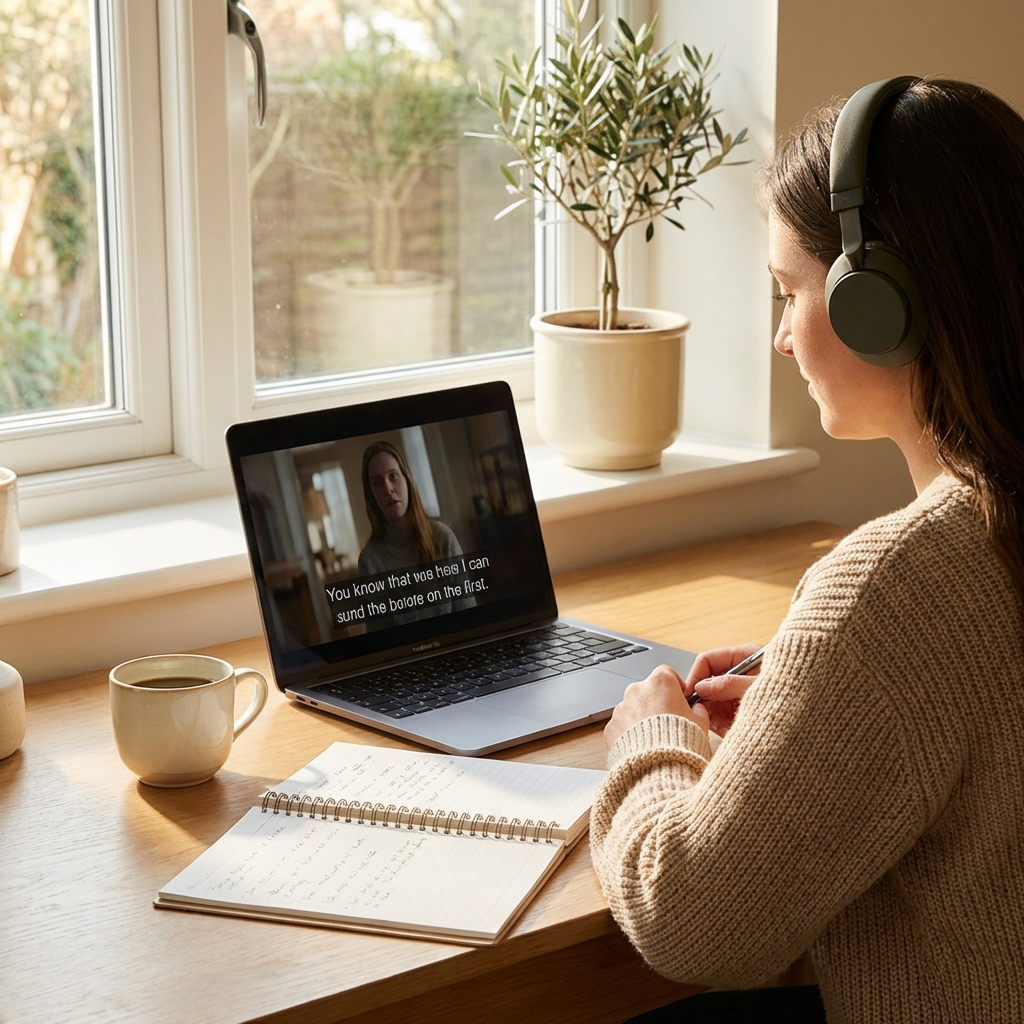
Using delayed captions for active listening training improves comprehension by forcing genuine audio processing.
Why Synchronous Captions Hold You Back
The Reading Trap
When you watch content with perfectly synchronized subtitles, research shows your eye movements tell the whole story: viewers spend 68-84% of their time looking at subtitles, not the video content.
Your ears become secondary. The audio might as well be background music.
The "Passive Viewing" Problem
Vanderplank notes that "passive" viewing — watching without engaging actively — leads to minimal learning. It's comfortable but ineffective. You finish an episode, enjoyed it, and learned almost nothing.
Compare this to "active" viewing: pausing, rewinding, dealing with slight caption delays. It's less comfortable but dramatically more effective for language acquisition.
The Illusion of Comprehension
With synchronized subtitles, you feel like you understand everything. And technically, you do — you read and understood the text. But this creates a false sense of listening ability.
Remove the subtitles, and reality hits: you could read but not hear.
How 1-1.5 Second Delay Transforms Your Learning
The Sweet Spot: 1-1.5 Seconds
Why specifically 1-1.5 seconds? Research suggests this timing is optimal because:
- Long enough to force genuine listening and hypothesis formation
- Short enough to maintain comprehension flow and prevent frustration
- Matches natural processing — roughly the time your brain needs to decode speech
Shorter delays (0.5s) don't create enough listening pressure. Longer delays (2s+) cause confusion and lost context. The 1-1.5 second range hits the sweet spot.
The Hypothesis-Test-Confirm Cycle
This is the magic of delayed captions:
- Hear the sound: "Ka-re-wa..." (in Japanese)
- Brain activates: "That sounds like 'kare wa' — he is..."
- Form hypothesis: "I think they're saying 'He is...'"
- Caption appears: "彼は" (kare wa)
- Confirmation: "Yes! I heard it correctly!"
- Reinforcement: Neural pathways for that sound strengthen
When you're wrong, the correction is immediate and painless. You heard "kore" but it was "sore" — now you know the difference, and you'll listen more carefully next time.
Building True Listening Confidence
Over time, something remarkable happens:
- You start understanding before the caption appears
- You catch yourself not needing to check the text
- Real conversations become more comprehensible
- The caption becomes confirmation, not translation
This is the goal: captions as safety net, not crutch.
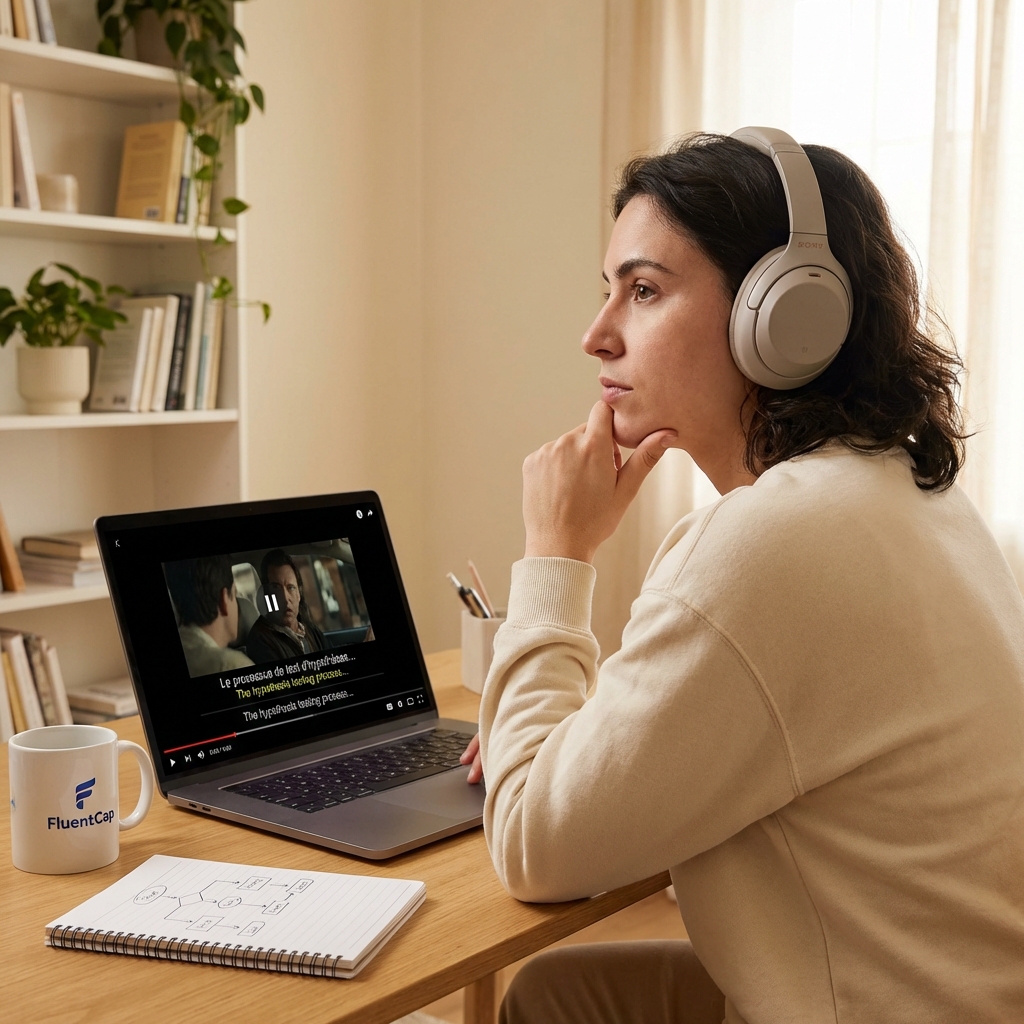
The hypothesis-test-confirm cycle builds genuine listening confidence over time.
Setting Up Delayed Captions with FluentCap
FluentCap makes delayed caption training straightforward. Here's how to configure it for optimal listening training:
Step 1: Enable Caption Delay
In FluentCap settings, you'll find the caption delay option. Set it to:
- 1.0 second for intermediate learners
- 1.5 seconds for advanced learners seeking challenge
- 0.5 seconds if 1.0 feels too difficult initially
Step 2: Choose Dual-Language Mode
Display both the original transcript and translation. The original transcript is your confirmation tool; the translation helps when you're truly stuck.
Step 3: Position for Minimal Distraction
Place the FluentCap window where you won't glance at it instinctively:
- Below the video (not overlay)
- In peripheral vision rather than central focus
- Slightly transparent if the option is available
Step 4: Practice Active Listening Protocol
For each scene:
- Watch without looking at captions
- Listen intently for 5-10 seconds
- Glance at captions to confirm
- Repeat
As you improve, extend the "listen-only" periods.
The 4-Week Active Listening Training Plan
Week 1: Adjustment Phase
Settings: 0.5s delay, frequent caption checking
Goal: Get comfortable with delayed confirmation
Daily practice: 20-30 minutes with beginner-friendly content
Focus: Notice how you're reading less and listening more
This week will feel strange. You're breaking the habit of reading-first. Trust the process.
Week 2: Building Confidence
Settings: 1.0s delay
Goal: Develop hypothesis-forming habit
Daily practice: 30-40 minutes with intermediate content
Focus: Practice saying what you heard before checking
Start verbalizing your guesses. "I heard 'taberu'... check... yes!" This external confirmation reinforces learning.
Consistent daily practice with delayed captions leads to measurable listening improvement in 4-6 weeks.
Week 3: Challenging Your Ears
Settings: 1.0-1.5s delay, try periods with captions hidden
Goal: Trust your listening ability
Daily practice: 40-50 minutes with varied content
Focus: Extended "listen-only" segments
By now, you should notice improvement. Test yourself with 30-second caption-free periods.
Week 4: Integration and Assessment
Settings: 1.5s delay, mostly verification-only usage
Goal: Measure progress, establish ongoing routine
Daily practice: 45-60 minutes, mixed approach
Focus: How much can you understand before captions confirm?
Compare your comprehension now to Week 1. The difference should be significant.
Most learners report 30-50% improvement after 6-8 weeks of delayed caption training.
Real Results: What to Expect
Short-Term (Weeks 1-2)
- Frustration: You'll realize how much you were reading
- Awareness: You'll notice your listening gaps
- Small wins: Catching words you previously missed
Medium-Term (Weeks 3-6)
- Improved word recognition: Familiar words jump out
- Pattern recognition: Common phrases become automatic
- Increased confidence: Real conversations feel more accessible
Long-Term (Months 2-6)
- Genuine listening comprehension: Understanding even without text backup
- Natural processing: Your brain stops waiting for visual confirmation
- Transfer to real life: Conversations, movies, podcasts become clearer
The Ultimate Test
Watch something completely new with no captions at all. Compare how much you understand now versus before training. Most learners report 30-50% improvement in pure listening comprehension after 6-8 weeks of consistent delayed caption training.
Thank You to Our Providers
FluentCap's real-time transcription is possible thanks to amazing speech-to-text providers:
- Deepgram: Offers $200 in free credits (~750 hours of transcription)
- AssemblyAI: Provides $50 in free credits (~140 hours)
- Gladia: Gives 10 free hours every month
- Shunya: Offers $100 in free credits (~300 hours)
These providers make language learning through delayed caption training accessible to everyone. When your free credits run out, we encourage you to support them — their rates are incredibly fair at just $0.15-0.40 per hour, 60-80% cheaper than subscription apps.
Ready to start training your ears? Download FluentCap now and configure your caption delay in Settings.
Frequently Asked Questions
Why 1-1.5 seconds specifically? Is there research on the optimal delay?
Research on subtitle timing suggests 1-1.5 seconds provides the optimal balance. Shorter delays don't create enough "listening pressure" — your brain knows text is coming immediately. Longer delays cause context loss and frustration. This window gives your brain time to process, hypothesize, and then confirm without losing the thread of conversation.
Won't delayed captions make understanding harder?
Initially, yes — and that's the point. Like any training, the challenge creates growth. "Desirable difficulty" is a well-established learning principle from Bjork & Bjork's research at UCLA. By making comprehension slightly harder, you force your brain to work harder, which leads to better long-term retention and skill development.
Can I use this technique with any content?
Absolutely. Delayed captions work with movies, TV shows, podcasts, YouTube videos, online courses — any audio content. The key is consistent practice. FluentCap works with any audio source on your computer, so you can apply this technique to whatever content interests you most.
How long until I see improvement?
Most learners notice changes within 2-3 weeks of consistent practice (20-30 minutes daily). You'll catch yourself understanding words before confirming with text. Significant improvement in pure listening comprehension typically takes 6-8 weeks. The gains are gradual but measurable.
Should I ever use synchronized captions?
Yes. Synchronized captions are still valuable for pure enjoyment, learning new vocabulary, and understanding complex content. The delayed technique is specifically for listening training. A balanced approach might be: 60% delayed captions (training), 40% synchronized (enjoyment and vocabulary expansion).
What if I can't understand anything without the instant captions?
Start with shorter delays (0.5s) and simpler content. The goal is challenge, not frustration. You should understand roughly 60-70% through listening alone; the captions confirm the rest. If you're below 50% comprehension, the content may be too advanced or the delay too long. Adjust until you find your productive challenge zone.
Start Training Your Ears Today
The path to better listening comprehension isn't removing captions entirely — it's changing your relationship with them. By delaying captions 1-1.5 seconds, you transform passive reading into active listening training.
Every video becomes an opportunity. Every foreign phrase becomes a test-and-confirm cycle. And gradually, your ears become as skilled as your eyes.
We built FluentCap to bring good things to the world. And we believe that truly hearing another language — not just reading it — opens doors to deeper understanding and connection.
Your next video is waiting. Set the delay, press play, and start truly listening.
Related Articles
More ways to improve your language learning with FluentCap:
- Learn Languages by Watching Movies — The complete guide to entertainment-based language learning
- How to Learn Japanese by Watching Anime — Apply active listening to anime with real-time transcription
- Watch Foreign Movies with Real-Time Subtitles — Enjoy films from any country with instant translations
— FluentCap Team
Every conversation. Every language. Understood.